
Eliminating NOC Noise at a Tier‑1 Telco with Scout and Splunk

Tier-1 Telco reduces NOC noise with Scout for reliability

Take a Product Tour

Short Description

A Tier-1 telco used Scout’s Event Intelligence Service (EIS) with Splunk to turn millions of raw events into event intelligence for operations, reducing NOC noise, false positives and double-digit MTTR all through the Reliability Path Index (RPI score); using the RPI framework, Six Sigma correlation and agent AI for next-best actions the telco accelerated incident handling and aligned IT and executive stakeholders on reliability.
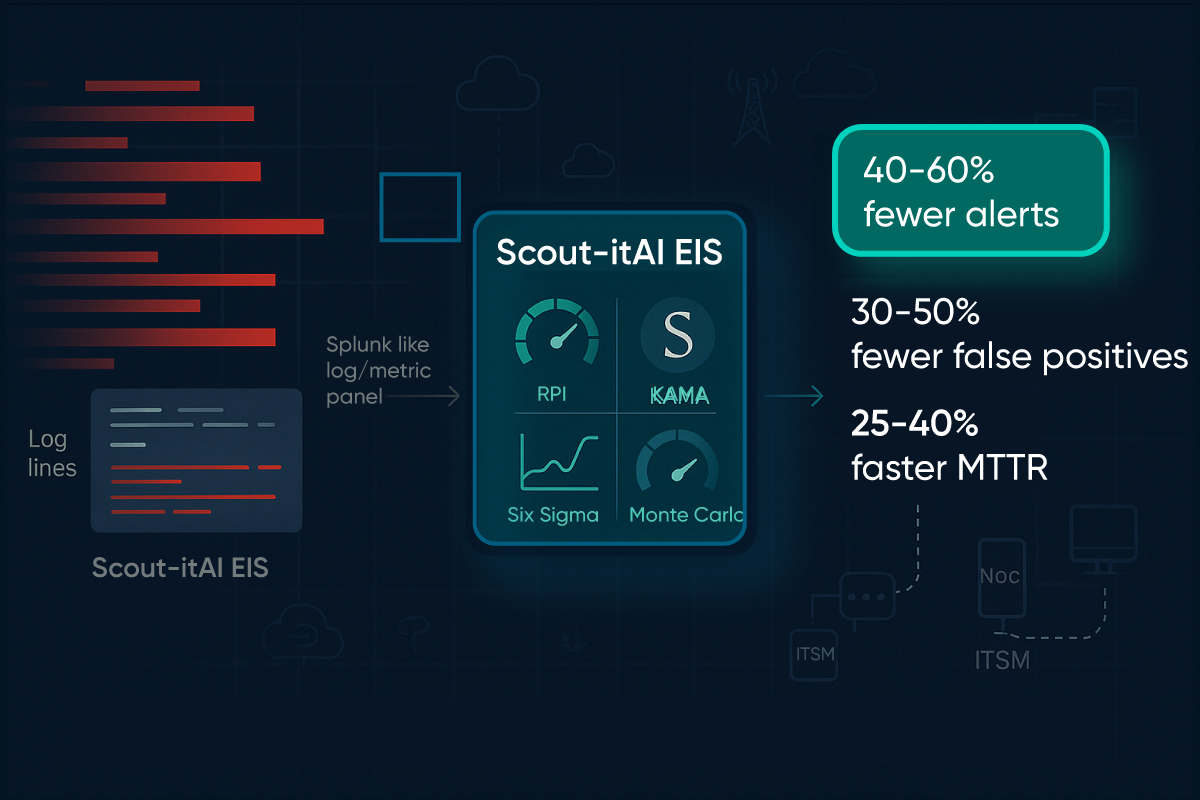
Scout EIS with Splunk reducing alerts, false positives, and MTTR

Problem Statement

  • Chronic alert fatigue from multiple tools (RAN, transport, 5G core, SD-WAN, cloud) feeding Splunk; duplicate notables and flapping events hiding real issues.
  • War-room delays and inconsistent triage increasing MTTR and SLA risk; executives had no single view of reliability.
  • Need to reduce false positives in NOC, standardize reliability reporting and automate next-best actions without adding another dashboard.

Solution architecture

Ingest & Context
  • Logs/metrics/traps into Splunk; topology/CMDB and SLAs enrich context.
  • Scout Splunk integration via HEC/REST searches; outputs reliability-centric insights back into Splunk notables and dashboards.
Analytics & Automation
  • RPI score (Reliability Path Index): 13-bucket model normalizes dissimilar metrics into one reliability language across services and regions.
  • Blender Six Sigma analysis for alerts/noise: Agentic AI for operations (agentic workforce): Orchestrator + sub-agents propose fixes, escalate with evidence, and trigger ServiceNow/Jira incident automation and ChatOps updates.Real-time correlation, deduplication, and alert suppression to quiet storms.
  • Trender KAMA monitoring (adaptive moving average): Detects slow degradations vs. a 100-day baseline to catch issues thresholds miss.
  • Predictor Monte Carlo forecasting (reliability): Up to 100k simulations estimate RPI impact of changes (capacity, firmware, routing).
  • Agentic AI for operations (agentic workforce): Orchestrator + sub-agents propose fixes, escalate with evidence, and trigger ServiceNow/Jira incident automation and ChatOps updates.

Results & Outcomes

  • NOC noise reduction: 40-60% fewer actionable notables after correlation, Splunk deduplication and suppression.
  • MTTR reduction: 25-40% faster resolution via auto-triage, playbook suggestions and richer context cards.
  • False positives: 30-50% lower through Six Sigma validation + KAMA trend confirmation.
  • Executive alignment: RPI-based reliability reviews replace tool-specific jargon; clearer prioritization of investments.

TCO considerations

TCO considerations Costs: Scout subscription, one-time connector setup, optional runbook automation effort (SaaS footprint minimizes infra spend). Offsets/Savings: Fewer Sev-1/Sev-2 escalations, shorter war rooms, reduced Splunk processing from deduped events, lower SLA penalties/churn risk, quicker analyst ramp. ROI accelerators: Start with one critical journey (e.g. 5G core data path), baseline noise/MTTR, then expand; use Monte Carlo forecasting to prioritize highest reliability ROI changes.

Lessons Learned

Standardize early around the RPI score, enrich with accurate topology/CMDB and pilot in one domain to tune correlation, dedup and suppression. Pair KAMA trends with thresholds and Six Sigma to curb false positives, keep a human-in-the-loop before selective auto-remediation and feed ITSM/ChatOps outcomes back to improve recommendations. Use RPI scorecards to keep executives aligned on business impact and investment priorities.