
Every second a retail operation is offline can mean lost revenue, abandoned carts, missed transactions, and damage to brand trust. But for many retail IT teams, the problem is not a lack of monitoring; it is information overload. When dashboards are flooded with thousands of alerts during peak trading hours, the signals that matter most can disappear into the noise.
This case study looks at how a large retail enterprise operating hundreds of stores alongside a high-traffic e-commerce platform worked with Scout to roll out an AI-powered Event Intelligence System (EIS), and transform how its operations team detects, prioritizes, and resolves incidents.
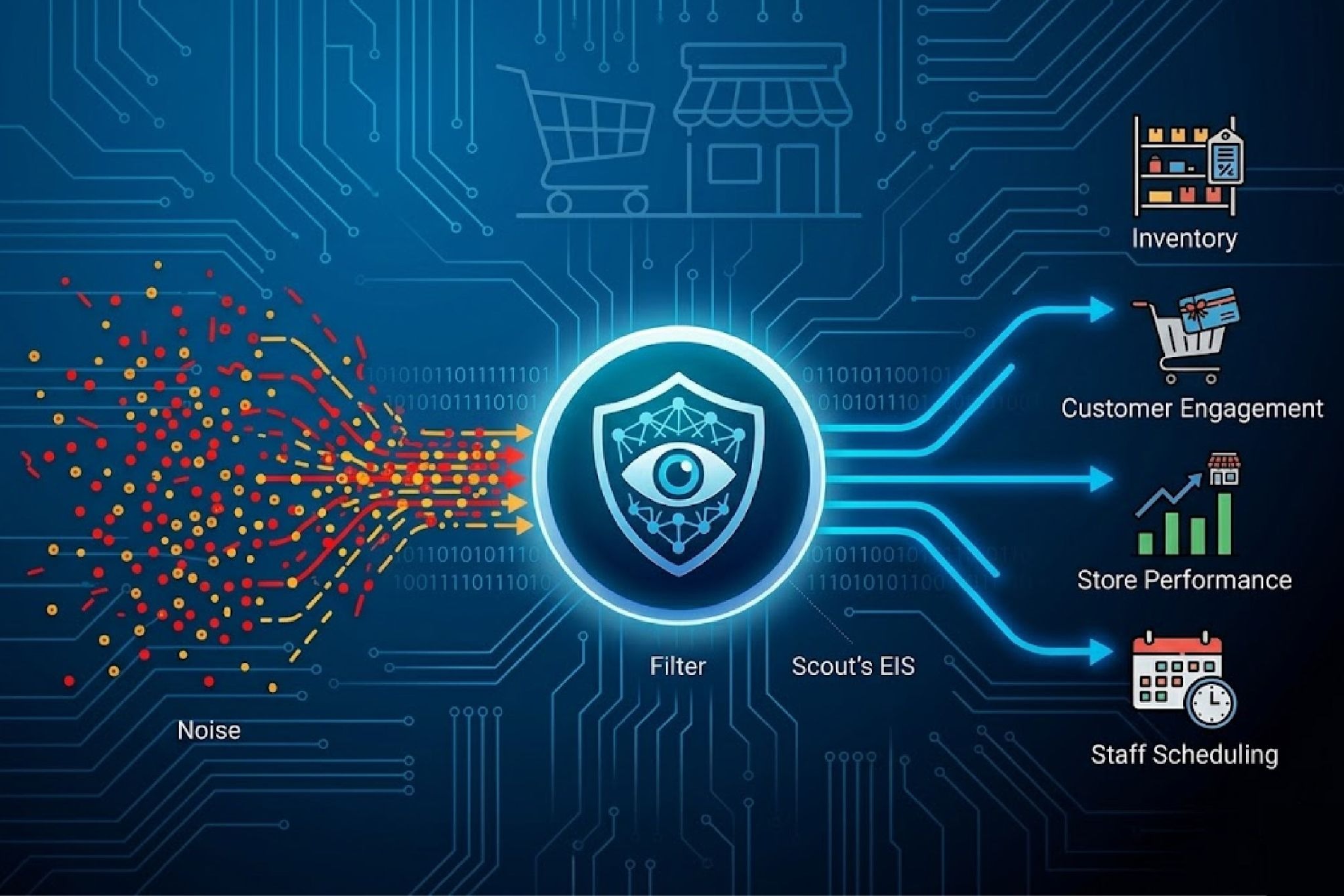
At first glance, a retail IT team plugging into network probes, app performance monitoring tools, POS gadgets, payment gateway monitors and cloud log aggregators should have all the visibility it needs. But the reality was far from it. On a typical day, the team was getting tens of thousands of notifications. During flash sales, holiday weekends, and big promotional events, that volume just kept on growing.
But having more alerts wasn't the same as getting more clarity.
The operations team found itself spending more time sifting through alerts than actually resolving incidents. Engineers were getting paged all the time, and a lot of those pages were about low-priority or false alarms. And as time went on, trust in the monitoring system started to erode, so teams started either ignoring or dismissing alerts - a pretty worrying pattern, especially when a real outage could be hiding in the noise.
The team also had a real problem figuring out which alerts were actually affecting the business in real time. When checkout systems were at risk, store transactions were faltering, or the e-commerce platform was down, leaders needed to know which issues were really impacting customers and revenue.
And for a business built around keeping checkout lines moving, the website up and running, and shoppers happy, this just wasn't a sustainable way to operate.
After checking out a few options, the customer chose Scout’s Event Intelligence System (EIS) - an AI-native platform that can process millions of events per second, find connections across different systems, and turn raw telemetry into insights that actually make sense to the business.
What made Scout stand out from the pack was that EIS wasn't just an extra layer of intelligence slapped on top of existing monitoring tools. It was an AI-native event intelligence architecture that could handle correlation, anomaly detection, prioritization, and summarization in the same way a human would.
The result? A single, reliable view of the operational health - ranked by business impact.
Scout’s EIS addressed the retailer’s alert overload in five coordinated stages.
1. Bringing All Signals into One Place. Telemetry from POS systems, payment gateways, e-commerce platforms, network infrastructure, cloud workloads, and existing monitoring tools was brought into a single intelligence pipeline. This allowed every event to be analyzed in a shared context, regardless of its source.
2. AI-Driven Correlation. The correlation engine grouped related events. A slow API call, a spike in payment errors, and a queue backlog were no longer treated as three separate alerts. Instead, Scout’s event intelligence capabilities recognized them as one linked incident with a shared root cause.
3. Business-Based Prioritization. Rather than treating every alert equally, Scout’s EIS prioritized incidents based on severity, customer impact, SLA risk, and revenue exposure. For example, a checkout issue during a promotion was immediately elevated, while a non-critical background warning could be suppressed for later review.
4. Anomaly Detection and Prediction. Machine learning models learned the retailer’s normal operating patterns and distinguished genuine anomalies from expected traffic fluctuations. In some cases, Scout’s EIS forecasted emerging problems before they became major incidents, giving engineers time to intervene proactively.
5. Noise Suppression and Smart Routing. EIS automatically filtered out duplicate, low-priority, and self-resolving alerts. Only validated, business-relevant incidents reached the on-call engineer along with the right context and routing to the appropriate team.
The Rollout: A Low-Risk Approach
EIS was introduced gradually to minimize disruption. Initially, it ran in parallel with the existing monitoring stack in observe-only mode, learning normal system behavior without affecting operations. Once tuned, intelligent suppression and routing were enabled in production.
At the same time, integration with Scout’s Reliability Intelligence Index (RI²) translated technical health into a single, easy-to-understand reliability measure for executives. Importantly, EIS was layered on top of the existing toolset rather than replacing it, allowing the customer to preserve its current monitoring investments.
By the end of the first full operational quarter, the impact was clear, measurable, and visible to both engineering and executive leadership.
The customer achieved a 97% reduction in alert noise, with tens of thousands of daily alerts reduced to a focused set of validated incidents each linked to a real business signal.
But the headline result was only part of the story. The operational improvements were equally significant:
The rollout showed that adding more monitoring tools does not solve alert overload; teams need intelligence that connects signals across systems and ties them to real business impact. By prioritizing incidents based on customer, revenue, and reliability risk, Event Intelligence helps teams trust alerts again, respond faster, reduce fatigue, and shift from reactive firefighting to proactive incident prevention. It also highlighted the importance of business context in IT operations, because not every technical issue carries the same level of risk. When teams can clearly see which incidents affect checkout, payments, stores, or online customers, they can make better decisions under pressure. The rollout also proved that gradual adoption reduces risk and helps teams build confidence in AI-driven operations. Over time, this approach improves collaboration across SRE, DevOps, network, and application teams. Most importantly, Event Intelligence becomes more than a monitoring enhancement; it becomes a foundation for reliable, scalable, and customer-focused retail operations. Ready to reduce alert noise and improve reliability? book a demo with Scout today to see how Event Intelligence can help your team detect, prioritize, and resolve incidents faster.



 No credit card required
