
Seeking to scale autonomous IT operations, the customer deployed Scout across a hybrid environment spanning roughly 500 monitored assets in AWS, Microsoft Azure, and on premises infrastructure. Specialized AI agents were assigned to prediction, incident correlation, remediation, reporting, and decision support, enabling SRE and DevOps teams to automate routine operational workflows. Each agent performed its own job well. The challenge wasn't the individual agents it was coordinating them.
Every workflow passed through a traditional orchestration engine that sequenced tasks and moved work from one agent to the next. That engine could tell an agent when to start. It could not tell the next agent whether the previous one had actually succeeded.
The real question had shifted. It was no longer how to build capable agents. It was how one autonomous agent could safely rely on another's output.
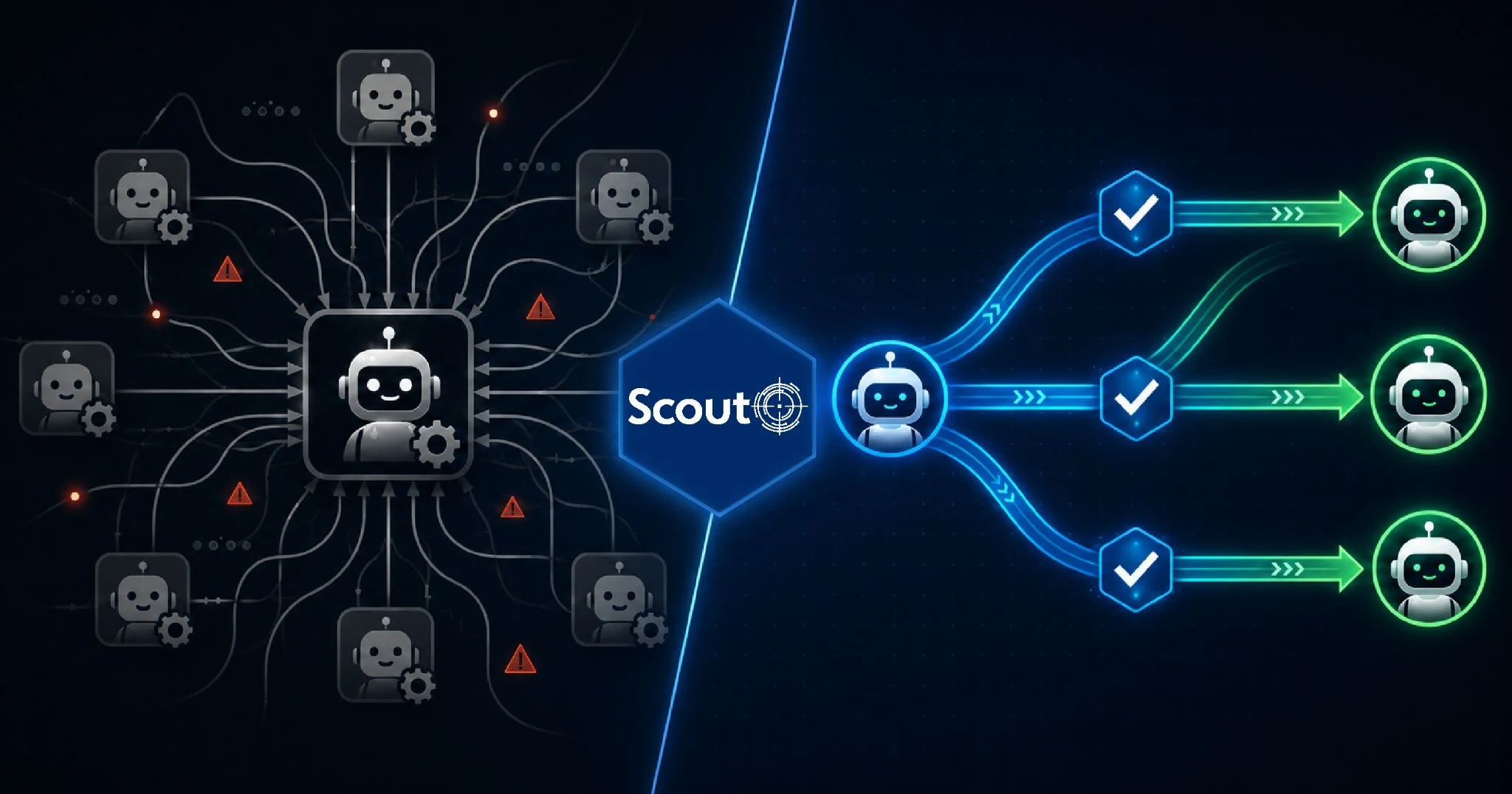
Distributed systems offer no shared memory, no global clock, and no guarantee that every participant finishes what it started. Command-based orchestration handled the sequencing but left the harder problem untouched.Four failure patterns recurred:
Scalability suffered too, though that was a symptom rather than the disease. The underlying problem was that agents were acting on assumptions. Small unverified handoffs compounded into workflow delays, avoidable escalations, and errors nobody could attribute.
Scout addressed this with Promise Theory, a scientific framework developed by Mark Burgess, in which autonomous agents cooperate through voluntary, verifiable promises rather than centralized commands.
Through Scout's Promise Engine, every agent declares three things explicitly:
Dependent agents rely on a promise only after the evidence has been independently checked. Scout's AI² Integrity Layer performs that check before execution continues. Two agents carry the governance load:
The Critic verifies whether an agent fulfilled its declared promise. It evaluates the supporting evidence, assigns an AI² Trust Score, and measures governance quality against ISO/IEC 42001 principles before downstream work proceeds.
The Bishop remains Scout's command and communication agent. What changed is where it sits. It no longer stands in the path of every routine handoff verified promises flow agent to agent. Instead, The Bishop coordinates the exceptions: routing retries, invoking fallbacks, translating signals into guidance, and escalating to humans when a promise cannot be kept.
That distinction matters for an honest reading of the architecture. The decision path decentralized agents stopped waiting on a controller to proceed. Verification and exception handling remain deliberately centralized, because both benefit from a single consistent view.
Rollout took six weeks: three weeks defining promises and evidence schemas, three weeks running verification in shadow mode alongside the existing orchestrator, and cutting workflows over in tiers.The resulting promise lifecycle has five steps:
Every interaction became a verified promise rather than an assumed command. Failures turned into visible, localized events.
After transitioning to promise-based coordination, the customer saw significant improvements in operational reliability, automation, and governance. Results from the first full quarter after cutover, compared to the previous quarter, include:
| Metric | Before | After |
|---|---|---|
| Workflow interruptions needing human unblocking | 34/week | 6/week |
| Mean time to detect a broken promise | 3.2 hours | 8 seconds |
| Agent handoff verification | Manual, ~40 min | Automated, 1.4 s |
| Manual intervention hours | 31/week | 12/week |
| Workflows completing without human touch | 41% | 78% |
| Agents in fleet without workflow redesign | 12 | 44 |
| Governance evidence preparation | 5 days/quarter | Continuous |
Operations also became more predictable. Because downstream agents received independently verified promises instead of unverified commands, they stopped pausing for centralized approval. Each fulfilled commitment carried an AI² Trust Score, giving engineering continuous evidence for compliance reporting and audits.
"We weren't short on capable agents. We were short on proof. Once every handoff came with evidence attached, the escalations mostly stopped." Director of Site Reliability Engineering
Multi-agent coordination is a trust problem, not a scheduling problem. Ordering work between autonomous agents is straightforward. Establishing that each outcome can be safely relied upon is the hard part.
Verification beats assumption. Every agent became responsible for declaring and proving its own behavior before another acted on it.
Decentralize the decision path, not everything. Removing the controller from routine handoffs improved throughput and resilience. Verification and exception routing stayed centralized on purpose distributing them would have cost consistency without buying much.
Failure must be loud. An agent that announces it cannot deliver is far less damaging than one that quietly stalls.
Governance becomes a byproduct. Combining the Promise Engine with the AI² Integrity Layer made ISO/IEC 42001 alignment a product of daily operations rather than a separate compliance exercise.
For teams building autonomous AI systems: rather than wiring agents to obey a controller, let them coordinate through promises they can prove.
Learn more about Scout's Promise Engine and Promise Theory governance



 No credit card required
