
Fortune 200 Reliability with Scout + Broadcom NetOps

Delivering Fortune 200 reliability through Scout plus Broadcom NetOps.

Take a Product Tour

Short Description

A Fortune 200 manufacturer modernized service reliability across plants, applications, and networks by pairing Scout itAI’s Event Intelligence Service (EIS) with Broadcom NetOps. Using the patented Reliability Intelligence Index (RI²), agentic AI, and deep integrations, the team translated noisy telemetry into plain-language, executive-ready answers cutting MTTR, shrinking alert fatigue, and aligning IT with business outcomes.
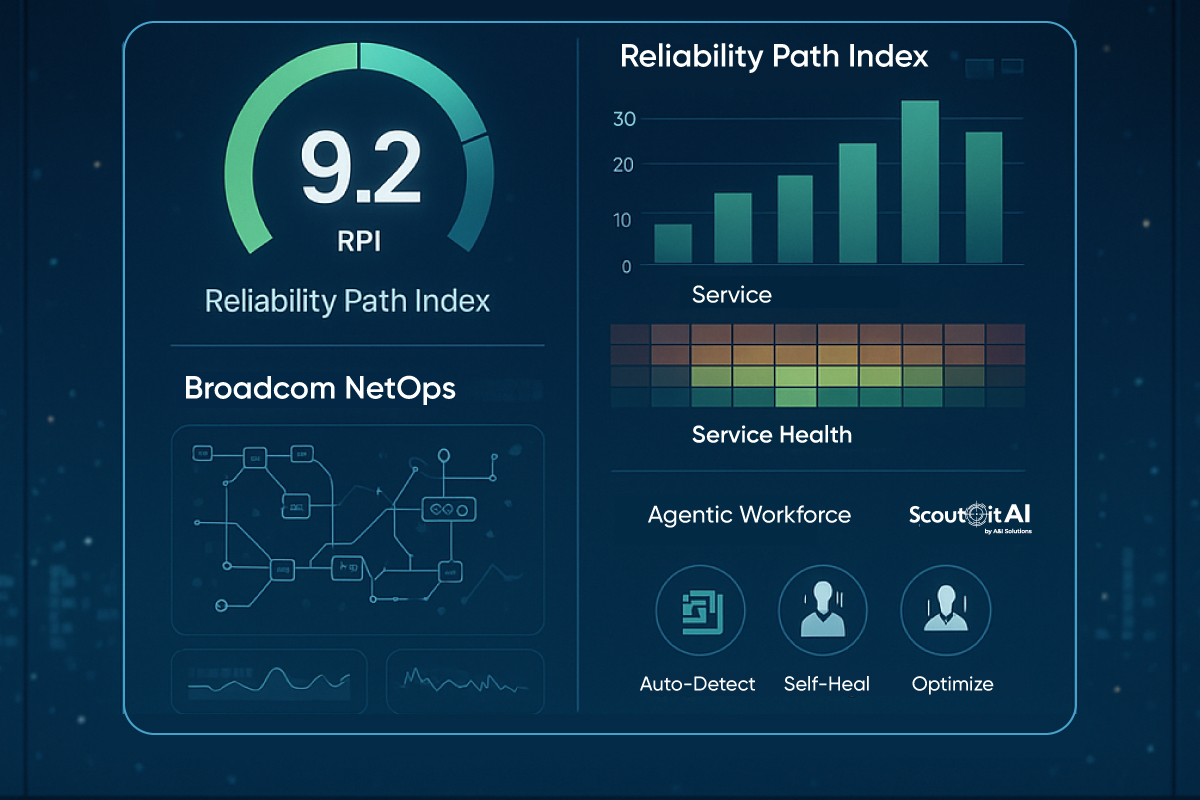
Fortune 200 Reliability with Scout + Broadcom NetOps

Problem Statement

  • Siloed tooling across mainframe, plant networks, SD-WAN, cloud apps, and ERP created conflicting signals and slow incident triage.
  • Executives lacked a single, standardized reliability score to compare diverse services and plants.
  • NOC teams faced high alert volumes with little business context; effort-to-impact was unclear.
  • Leadership demanded forecastable reliability ROI and transparent progress—without “techy jabber.”

Architecture

Telemetry Foundation (Broadcom NetOps)
  • DX NetOps/OI ingests flow, SNMP, SD-WAN, and performance metrics from plant, WAN, and data center.
  • Exports curated alarms/metrics to Scout via secure connectors.
Dynatrace–Scout architecture diagram showing data flow to RI² 98/100 and automated runbooks
Scout Event Intelligence Service
  • RI² Engine (13 buckets) condenses thousands of KPIs into a single, standardized reliability score per business service/plant
  • Blender (Six Sigma) correlates alarms + metrics in real time to isolate performance-impacting patterns.
  • Trender (KAMA) tracks 100-day baselines to detect slow degradations and early drift.
  • Predictor (Monte Carlo) runs up to 100,000 simulations to show how changes (capacity, patching, topology) shift future RI².
  • Agentic Workforce (orchestrator + sub-agents) automates root-cause hypotheses, escalation, and safe self-corrections with governance.
  • Plain-Language Insights translates telemetry into business risk statements and recommended actions.
Integrations & Consumption
  • Bidirectional hooks with ITSM (e.g., ServiceNow) for auto-ticketing and playbook execution.
  • Executive scorecards and service heatmaps exposed to CIO/COO; NOC dashboards for real-time action.
  • Cloud-agnostic coverage (AWS/Azure/GCP/on-prem) with up to 12 months history.

Results & Outcomes

  • MTTR ↓ 41% via AI-guided triage and automated playbooks.
  • P1/P2 incident volume ↓ 28% after Six Sigma-based noise reduction and correlation.
  • Alert fatigue ↓ ~60% by focusing operations on 13 RI² buckets tied to business impact.
  • SLA breach risk ↓ 32% as Trender exposed slow degradations before they became outages.
  • Executive alignment: Monthly RI² scorecards enabled plant-to-plant and service-to-service comparisons in one number, boosting trust and funding for reliability work.
  • Predictable planning: Monte Carlo forecasts quantified reliability ROI for network upgrades and patch windows, improving change-adoption decisions.

TCO & Operational Efficiency

  • Tool Consolidation: Leverage Broadcom NetOps as the authoritative network signal, unify with app/infrastructure telemetry inside Scout—fewer overlapping licenses and dashboards.
  • People Efficiency: Agentic automation offloads repetitive triage, freeing senior engineers for systemic fixes.
  • Incident Cost Avoidance: Fewer high-severity incidents and faster recovery reduce downtime costs on production lines.
  • SLA breach risk ↓ 32% as Trender exposed slow degradations before they became outages.
  • Cloud & Data Costs: Smart sampling and reliability-bucket focus limit data egress and storage while preserving decision-grade fidelity.
  • Adoption & Training:Plain-language insights shorten onboarding; RI² makes non-technical reviews efficient (less analyst time to prep decks).

Lessons Learned

Start with Business Services: Map plants/lines and critical apps to RI² early; don’t boil the ocean.

Govern the Agents: Define safe-action guardrails and rollback paths; measure success per action.

Baseline Before You Tune: Use KAMA-based trends for ~100 days to separate structural issues from noise.

Make It Executive-Ready: Lead with RI² and risk statements; keep metric firehoses behind the scenes.

Forecast to Fund: Use Monte Carlo deltas to justify network and capacity investments with quantified reliability ROI.

Close the Loop: Pipe plain-language recommendations into ITSM playbooks and track outcome KPIs (MTTR, change success rate, RI² lift).