Healthcare AI Agents

Healthcare AI Agents Built for Human Oversight

Support clinical and revenue workflows with governed AI

Healthcare teams need more time for patient care, clearer access to clinical data, and more structured administrative work. Scout's suite covers four workflows, and each agent produces a first pass while clinicians and billing staff make final decisions.

Explore the Four Agents
  • Drafts, not decisions
  • HIPAA-aware deployment
  • Reviewable output

The Healthcare Suite

  • AIScriber Clinical documentation
  • Aria Clinical data questions
  • Wound Assessment Assistant Structured wound documentation
  • Denial Management Agent Denied-claim review
Every output is reviewed by a qualified professional
The Suite

Four purpose-built AI agents for healthcare teams

AI clinical documentation from encounter transcripts

AIScriber

Turns encounter transcripts into draft SOAP notes for clinician review.

Inputs

Supplied encounter transcripts, including those from Amazon Transcribe Medical.

Outputs

Draft notes in Subjective, Objective, Assessment, and Plan sections, with Quality Notes and suggested ICD-10 codes.

Capabilities

  • Separates patient-reported information from provider observations.
  • Captures stated medication changes.
  • Flags missing or contradictory details.
  • Identifies documentation gaps and uncertain transcript segments.
  • Produces structured output for integration planning.

Guardrails

  • Suggested ICD-10 codes rely only on explicitly documented diagnoses and need professional review.
  • Does not guess unnamed drugs or assign vague “unspecified” codes when laterality or severity is missing.
  • Clinicians verify and sign the final note.
Ask clinical data questions in plain English

Aria

Lets authorized teams find answers in connected clinical databases.

Inputs

Plain-English questions and connected data sources.

Outputs

Answers with supporting tables and source references.

Capabilities

  • Retrieves information from connected sources.
  • Explores population counts, trends, and summaries.
  • Shows reporting periods and data sources.
  • Identifies missing or incomplete records.

Guardrails

  • Uses read-only queries and never modifies patient records.
  • Does not recommend diagnoses or treatments.
  • Treats “no records found” as absence of data, not as evidence of health.
  • Database compatibility is confirmed during solution planning.

Structured wound documentation support

Wound Assessment Assistant

Creates consistent wound documentation across clinicians and care settings.

Inputs

Wound images and/or clinician observations.

Outputs

Structured draft for qualified review: wound type, approximate size, possible infection signs, healing stage, and evaluation frameworks (Wagner, Braden risk context, COLOR).

Capabilities

  • Organizes observations on tissue, edges, surrounding skin, and exudate.
  • Highlights uncertainty and documentation gaps.
  • Flags warning signs that may need prompt in-person attention.
  • Supports telehealth, home health, post-acute, and wound care teams.

Guardrails

  • Offers documentation and education only, not a definitive diagnosis or treatment plan.
  • Photographs alone do not establish precise measurements.

AI support for denied-claim review

Denial Management Agent

Gives revenue cycle teams a structured starting point for denied claims.

Inputs

Exported claims data and remittance information, including CARC/RARC codes.

Outputs

Suggested next steps (resubmission, appeal, write-off, or additional information review), proposed corrections, and deadline risk notes.

Capabilities

  • Identifies missing data and proposed corrections.
  • Prioritizes claims by billed amount and estimated deadline risk.

Guardrails

  • Sends low-confidence claims (below 0.70), large-dollar claims, and all appeals or write-offs to human review.
  • Billing staff verify payer deadlines and eligibility.
  • Identified amounts are not guaranteed recoveries.
  • Does not submit claims or appeals.
Governance

Healthcare AI governance that makes review part of the workflow

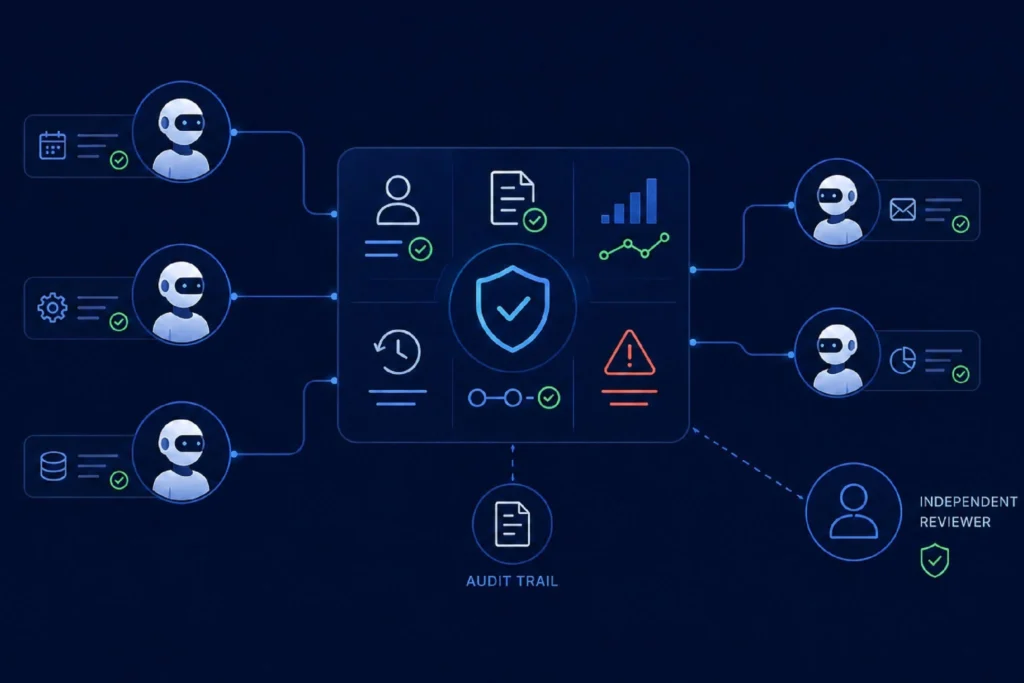
Reliable healthcare AI needs visibility into how outputs are produced and where human judgment applies.

The suite works from supplied or connected information, flags missing details, and keeps outputs as drafts, summaries, or recommendations.

Scout's governance relies on The Critic and AI² to set verifiable commitments for agent behavior and maintain human oversight.

How output moves through review

  1. Agent works from supplied or connected information
  2. Missing or uncertain details are flagged
  3. Output stays a draft, summary, or recommendation
  4. A clinician or billing professional makes the final decision
Assess before you adopt

Can you evaluate output integrity, not just agent availability?

Scout recommends exploring governance and output assessment during a demonstration.

AWS

Align healthcare AI with your AWS environment

Scout offers AIScriber built around Amazon Bedrock for AWS-based organizations.

Customers start with a defined workflow and confirm data connections, access requirements, and deployment architecture.

AIScriber can work from transcripts produced by AWS Transcribe Medical.

Privacy and security

Plan for privacy, security, and compliance

Deployment requires attention to protected health information, access controls, data retention, and review responsibilities.

Scout's security team helps evaluate controls, HIPAA requirements, hosting, and business associate agreement needs.

Get started

Start with the workflow that matters most

Medical groups

Draft encounter notes for review

Start with AIScriber.

Care coordination and quality teams

Query connected clinical data

Start with Aria.

Telehealth, home health, post-acute

Standardize wound documentation

Start with the Wound Assessment Assistant.

Revenue cycle and billing

Organize denied-claim review

Start with the Denial Management Agent.

Pilot guidance: Evaluate the chosen agent with representative, de-identified inputs and agreed review criteria before expanding use.

Frequently Asked Questions

Everything You Need to Know

Get answers to common questions about Scout, our AI agents, and the agentic transformation platform.

Scout is a governed agentic platform that helps organizations monitor IT environments, manage AI agents, improve operational reliability, and accelerate their transition to an agentic enterprise.

Scout uses specialized AI agents to analyze data, identify issues, provide insights, and support automated workflows across different areas of IT and business operations.

Scout helps organizations assess their readiness, identify high-value AI opportunities, build and deploy AI agents, and manage them across the enterprise.

RI² is Scout's reliability metric that combines infrastructure and operational data into a unified score, helping teams understand system reliability and identify potential issues.

Mission Control provides a centralized environment for using and monitoring AI agents across teams, departments, and business functions.

Scout provides governance capabilities, AI controls, oversight, and accountability mechanisms to help organizations operate AI agents in a controlled and responsible way.

Yes. Scout can work with existing monitoring and observability tools, allowing organizations to use their current infrastructure while adding AI-powered intelligence and automation.

Scout's Agentic Transformation Platform provides ready-made AI agents and pre-built enterprise workflows for common IT operations. Users can select a pre-made agent or workflow, provide the required input or evidence, and run the analysis to review the results.

You can book a demo with Scout. Our team will reach out, provide a walkthrough, and guide you through the purchase and setup process.

Yes. Scout is SOC 2 Type II certified, HIPAA compliant for healthcare-ready deployments, and recognized as an AWS Qualified Software Partner, reflecting its commitment to enterprise-grade security and compliance.

Explore a healthcare AI workflow with Scout

See how purpose-built agents can support clinical or revenue cycle teams while keeping professional judgment central.