Building an AI agent is getting easier. Getting security leaders to trust that agent with real systems, sensitive data and production workflows is much harder.
That can be one reason enterprise AI projects slow down.
Agents can read tickets, call APIs, update records and trigger workflows. But once an AI system can take action, organizations need more than model-level safety. They need visibility, access controls, clear boundaries, human oversight and evidence showing what the agent actually did.
That is the foundation of AI agent security.
What Is AI Agent Security?
AI agent security is the set of controls used to protect autonomous AI agents and the systems they interact with.
Unlike a chatbot that mainly generates responses, an AI agent may be able to access databases, use business applications, call APIs, communicate with other agents and execute tasks without constant human involvement.
That changes the security question. Instead of asking “Is this response safe?”, organizations also need to ask “Was this action authorized, within scope and properly verified?”
Why the Enterprise Trust Gap Exists
Security teams are not necessarily against AI agents. They simply need confidence that autonomy can be controlled.
Three practical areas to assess are visibility, control and evidence.
- Lack of visibility. Teams may not know which agents exist, who owns them or what systems they can access.
- Lack of control. Agents may receive broader permissions than they actually need, with unclear processes for limiting, pausing or disabling them.
- Lack of proof. Raw logs may show that an action happened, but they may not clearly explain why it happened or whether it was allowed.
An AI agent can perform well in a pilot and still struggle to reach production if the organization cannot demonstrate that its risks are appropriately controlled.
How Agentic AI Changes the Security Model
Traditional applications usually follow predefined logic. AI agents can interpret instructions, choose tools and adapt their actions.
That flexibility introduces new risks.
| Risk | Why It Matters |
|---|---|
| Excessive permissions | Agents may access more systems or data than necessary. |
| Prompt injection | Malicious instructions may influence agent behavior. |
| Tool misuse | Approved tools may be used in unintended ways. |
| Data leakage | Sensitive information may be exposed through actions or outputs. |
| Credential exposure | Leaked or overly privileged API keys and service credentials can enable unauthorized access. |
| Behavioral drift | Changes to models, prompts, tools or operating conditions can alter agent behavior and introduce new risks. |
| Uncontrolled autonomy | High-risk actions may happen without human review. |
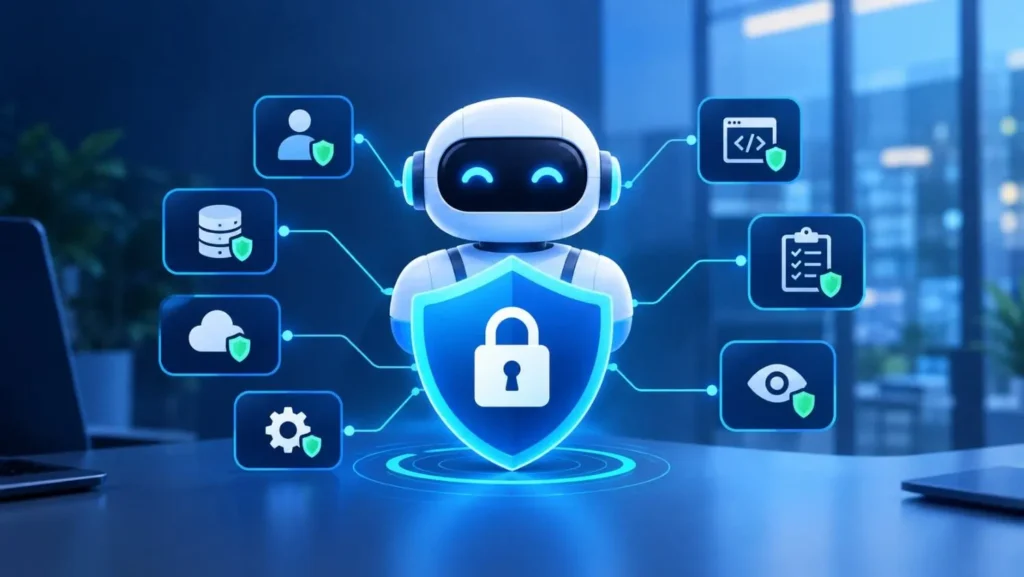
AI agent security therefore has to cover identity, access, tools, data, runtime behavior and actions.
Start With Identity and Least Privilege
Every production agent should have a clearly defined identity and owner.
Teams should know what the agent is designed to do, which systems it can access and who approved those permissions.
Agents should also follow the principle of least privilege. For example, an agent designed to summarize support tickets may need permission to read records but should not automatically be allowed to delete or modify them.
Permissions should be limited to the agent’s role and reviewed as that role changes.
Secure Tools, APIs and Inputs
Tools are what make AI agents useful, but they also increase risk. An agent may connect to cloud platforms, databases, ticketing systems, CRM tools or internal APIs.
Organizations should define which tools the agent can use, which actions are permitted and when approval is required.
They also need protection against prompt injection and indirect prompt injection. External documents, websites, emails or support tickets should be treated as untrusted input. An agent should not automatically follow every instruction it encounters simply because that instruction appears inside retrieved content.
Is Your AI Agent Environment Actually Secure?
Monitor What Agents Actually Do
Security does not stop when an agent is deployed. Teams need runtime visibility into:
- What task the agent attempted
- Which tools it used
- Which systems it accessed
- What actions it completed
- Which actions were blocked
- Whether human approval was required
- Whether the agent stayed within its defined boundaries
This becomes especially important in multi-agent environments where several agents may communicate or delegate tasks to each other.
Security teams need to understand not only the final result, but also how that result was produced.
Use Human Oversight for High-Risk Actions
Not every action needs human approval. Tasks such as summarizing information or categorizing tickets may run automatically when the data sensitivity, permissions and downstream consequences have been assessed as low-risk.
Higher-risk actions should receive stronger controls. That may include modifying production infrastructure, deleting records, changing customer accounts, handling regulated information or making financial decisions.
The objective is risk-based autonomy. Organizations should allow automation where the risk is low while keeping human control over actions with greater operational or business impact.
Building Trust Through Governance
Security controls become stronger when they are connected to a clear governance model. For every production agent, organizations should be able to answer:
- Who owns the agent?
- What is it supposed to do?
- What can it access?
- What actions has it taken?
- Can those actions be audited?
- Can the agent be paused or disabled quickly?
These questions also support broader AI risk management and audit readiness.
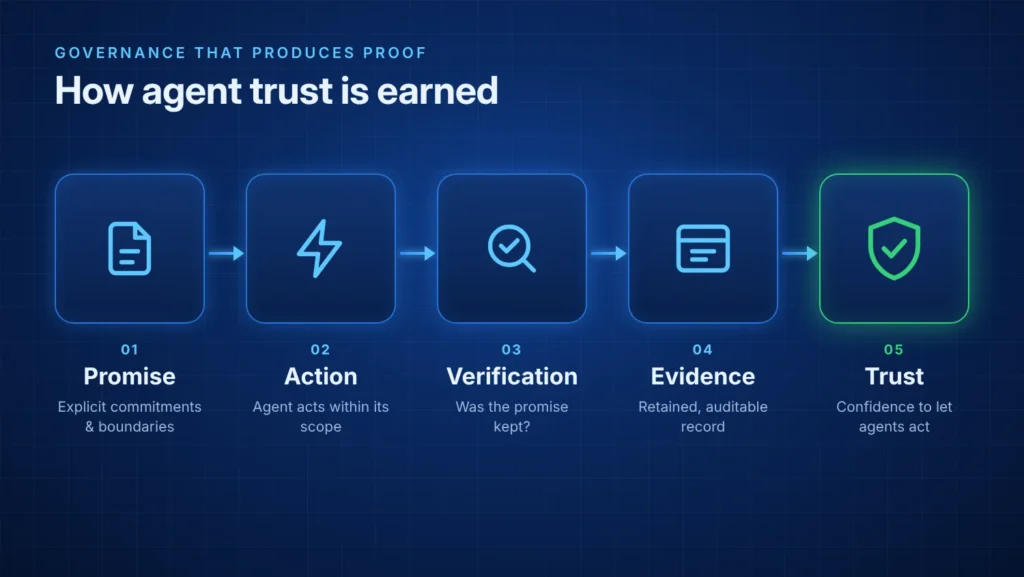
Scout applies Promise Theory to AI agent governance. The idea is to make agent commitments and boundaries explicit rather than assuming an agent will behave correctly simply because it received instructions.
The trust flow can be represented as: Promise → Action → Verification → Evidence → Trust.
When commitments are paired with verification and retained evidence, this can create a record of expected behavior and observed outcomes. For more detail, see Scout’s guide to the AI agent governance framework.
How Scout Supports Governed AI Agents
Scout Agent Studio provides a low-code environment for building, deploying and governing AI agents with guardrails, traceability and human oversight built into the lifecycle.
Mission Control gives teams centralized visibility into their AI workforce so they can monitor activity, review behavior and intervene when necessary.
Scout describes Agentic Assessment and Discovery as a way to discover shadow agents and assess opportunities for governed AI adoption. Scout describes its Promise Engine as evaluating agent commitments, with The Critic assessing whether those commitments are met and contributing to AI² Trust Scores.
Scout describes its Promise Engine as evaluating agent commitments, with The Critic assessing whether those commitments are met and contributing to AI² Trust Scores.
Together, these capabilities can support security reviews, governance and audit readiness. However, no platform automatically makes an organization compliant. Compliance still depends on the policies, processes and controls implemented around the technology.
AI Agent Security Checklist
Before moving an agent into production, organizations should confirm that:
- Every agent has a defined owner and purpose.
- Access follows least-privilege principles.
- Credentials and API keys are protected.
- Approved tools and actions are clearly defined.
- Untrusted inputs are separated from trusted instructions, and tool access and output handling are constrained.
- High-risk actions require stronger validation or approval.
- Runtime activity is monitored.
- Agent behavior can be audited.
- Agents can be paused or disabled quickly.
- Evidence is available for security and governance reviews.
Conclusion
The future of enterprise AI will not depend only on how intelligent agents become. It will depend on how confidently organizations can let them act.
That requires identity, access control, secure tools, monitoring, human oversight and verifiable evidence. The goal is not to remove autonomy. It is to make autonomy accountable.
Organizations that build these controls into their AI agent architecture from the beginning will be better positioned to move agents from pilot projects into real production workflows.
Explore Scout Agent Studio to see how organizations can build, deploy and govern trusted AI agents from one centralized platform.
Frequently Asked Questions
AI agent security is the set of controls that keep autonomous agents within authorized boundaries: permissions, tool and data access, approval thresholds, and evidence of what the agent did. Because agents act, the question becomes whether an action was authorized and provable.
Pilots can stall for several reasons, including integration challenges, data quality, costs and unclear business value. Security-related barriers can include limited visibility, insufficient access controls and inadequate evidence of agent behavior.
Risks include prompt injection, excessive permissions, tool misuse, data leakage, credential exposure and insufficient traceability. OWASP’s 2025 Top 10 for LLM Applications includes Prompt Injection (LLM01) and Excessive Agency (LLM06).
Inventory agents, assign owners, restrict permissions, protect credentials, constrain tools and untrusted inputs, and set approval thresholds by risk. Keep sufficient activity records for investigation and audit while protecting sensitive data in logs. Reassess after material changes.
Promise Theory models autonomous agents through explicit, voluntary commitments and assessments of whether those commitments are kept. Scout applies this approach to agent governance. Security still requires enforced permissions, secure tools and human oversight; commitments alone do not guarantee safety or compliance.

John Balsavage
President