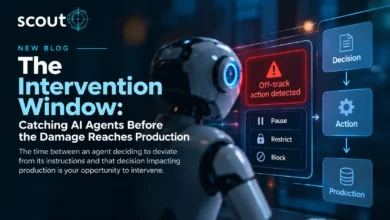
An agent passes testing, gets approved, and goes live. Six weeks later its model is updated, a new tool is connected, and its permissions quietly widen. Is it still the agent you approved?
That question sits underneath every enterprise decision about trusted AI agents. Approval is a moment. Trust is a record, and it has to keep being written. This article offers a way to judge whether an agent has earned more autonomy, and what should take it back.
What Are Trusted AI Agents?
Trusted AI agents are autonomous agents whose behavior an enterprise has verified against explicit commitments and continues to verify over time. Trust is not a product label or a one-time approval. It is a judgment supported by evidence that the agent stays within its boundaries, does what it said it would do, and can show its work.
A capable agent with no record is still an unknown.
Why Trust Gets Harder as Autonomy Grows
When an agent only recommends, a person is the control. When the agent acts, that safety net moves out of the loop, and the quality of the agent’s own commitments starts to carry the weight.
Three things make this harder. Agents change: models, tools, and prompts get updated. Context changes: behavior differs under quiet and stressed conditions. And at thousands of decisions a day, an agent cannot be sampled by hand.
Trustworthy AI, Governance, and Trusted Agents: Three Different Questions
These terms get used interchangeably. They answer different questions.
Trustworthy AI asks about the qualities of a system: whether it is reliable, transparent, secure, and fair. AI agent governance asks about rules: who owns the agent, what it may touch, and when a person must approve. Trusted AI agents ask something narrower and more practical: given everything we have seen, how much should we let this agent do on its own?
Governance is the foundation, and how enterprises govern AI agents deserves its own treatment. But governance can be complete on paper while trust remains unearned. The NIST AI Risk Management Framework and ISO/IEC 42001 both treat trustworthiness and management as ongoing work.
Is Your AI Agent Ready for More Autonomy?
Five Questions That Decide Whether an Agent Has Earned Trust
Use five questions. Each produces evidence you can inspect.
1. Scope: What did the agent commit to, and what did it refuse?
A trusted agent has stated, in advance, what it will do and what it will not. “Restart this stateless service under these conditions” is a commitment. “Help with operations” is not.
2. Conduct: Did it stay inside that scope?
Compare behavior to commitment, including the quiet cases: actions skipped, boundaries respected, escalations raised.
3. Proof: Can someone other than the agent show it?
Self-reporting is weak evidence. Verification should be independent of the agent being judged, and the result should be recorded with the context, policy version, and data involved, so a reviewer can reconstruct why an action was allowed.
4. Change: What resets the trust?
A new model, added tool, wider permission, or different workflow changes what was tested. Decide in advance which changes trigger reassessment.
5. Consequence: What happens when a commitment breaks?
Define how autonomy narrows when a commitment fails, who is told, and what evidence is needed before it is restored. The ability to withdraw autonomy is what makes it safe to grant.
Trust in Multi-Agent Environments
Trust does not pass automatically from one agent to the next. (For how commitments work between cooperating agents, see Promise Theory for Multi-Agent AI Systems .) When one agent delegates to another, the receiving agent needs its own commitments and its own record, otherwise the chain is only as trustworthy as its least examined member.
If one agent breaks a commitment, its remit narrows and the rest of the agentic workforce keeps working.
Making Trust Operational with Promise Theory
One way to make those questions run continuously is Promise Theory, a model of how autonomous agents cooperate through explicit, verifiable commitments about their own behavior. Scout Agentics applies it specifically to agent governance: commitments, boundaries, accountability, and verification.
The flow is simple to state: promise, action, verification, evidence, trust. An agent declares what it will and will not do. It acts. Its behavior is checked against the promise. The result is recorded as evidence. Trust is whatever that accumulated evidence supports, a theme explored further in Promise Theory principles and applications for agentic trust. In Scout’s platform, an evaluation agent called The Critic continuously assesses agent behavior and calculates AI² trust scores.
Scout Agent Studio is where teams build, deploy, and govern agents, with policy enforcement, human-in-the-loop controls, and traceability attached from the start. No platform makes an organization compliant or an agent risk-free. The value is structure and evidence that help trust become a judgment you can defend.
Is This Agent Ready for More Autonomy? A Readiness Checklist
Before widening an agent’s remit, ask whether you can answer yes to each:
- Are its commitments written down, including what it will not do?
- Has its behavior been compared to those commitments over a meaningful period and varied conditions?
- Is verification independent of the agent itself?
- Is the evidence recorded with enough context to reconstruct decisions?
- Do you know which changes, such as model, tools, permissions, or workflow, trigger reassessment?
- Is there a named owner who will act when a commitment breaks?
- Can autonomy be narrowed quickly without shutting down the program?
Conclusion: Trusted AI Agents Are Proven, Not Presumed
Trusted AI agents are not the ones with the best demo or the longest approval trail. They are the ones that can show what they promised, what they did, and why the two match, again and again, under changing conditions.
Autonomy is easier to grant when it is easy to take back. Build for that, and the question stops being whether to trust your agents and becomes how much, for which tasks, and on what evidence.
Explore Scout Agent Studio to see how enterprises can build, deploy, and govern trusted AI agents from one platform.
Frequently Asked Questions
Trusted AI agents are autonomous AI systems that demonstrate reliability, accountability, and consistent behavior through continuous verification and evidence-based trust.
Enterprises can build trusted AI agents by defining clear commitments, verifying actions, monitoring behavior, and adjusting autonomy based on proven performance.
AI agent governance defines rules and boundaries, while AI agent trust measures whether an agent consistently follows those rules and earns greater autonomy.
An AI agent verification framework evaluates agent behavior, validates commitments, records evidence, and helps enterprises make informed decisions about AI agent autonomy.
Promise Theory establishes clear, verifiable commitments for AI agents. It helps enterprises assess agent accountability, verify behavior, and build trust through continuous evidence.

John Balsavage
President