Introduction
Most enterprise governance was designed for systems that do exactly what they’re told. A central controller gives an instruction and a downstream component follows it. But that model’s no longer working for autonomous systems running your infrastructure. They don’t wait for permission every step of the way; they observe, decide, and act on their own. So “did the system follow orders” isn’t the right question anymore. What we should be asking is “did the agent keep its promises and can we actually prove it?”
That’s where Promise Theory comes in. It was built to address the problems of autonomous systems. Rather than trying to govern them with a never-ending stream of commands that they may or may not follow, you govern them by the promises they actually make and the outcomes you can verify yourself. This article looks at why command-and-control governance breaks down in agentic environments, what changes when you switch to governing by promises, and how Scout applies Promise Theory to make AI agent governance more transparent, accountable, and verifiable.
Why Command-and-Control Governance Breaks Down in Agentic Systems
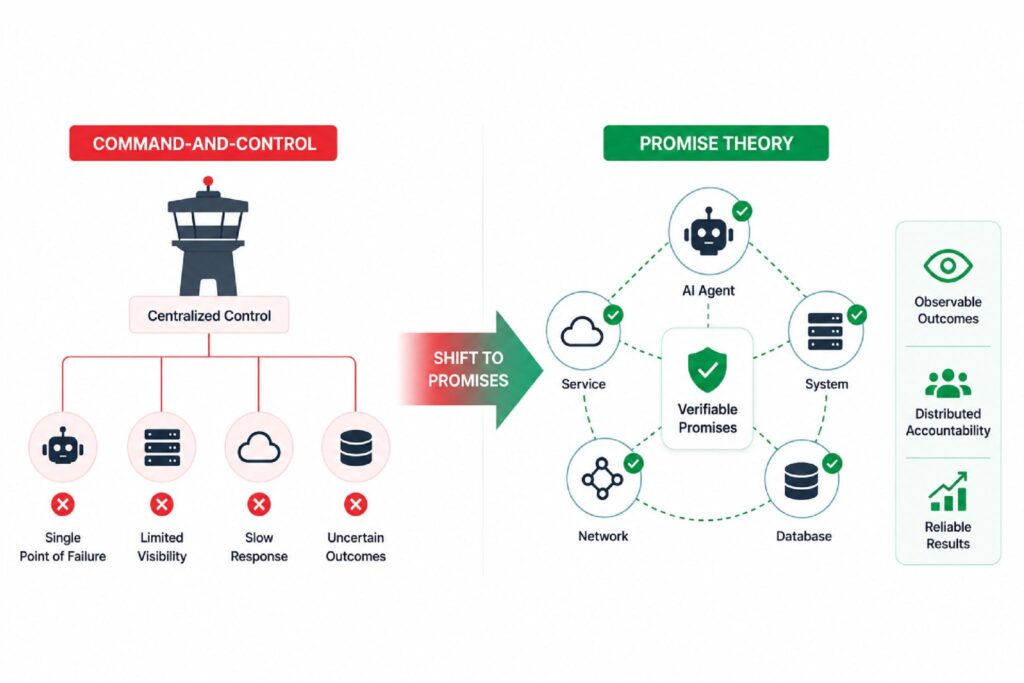
The problem with command-and-control is that it assumes a central controller can actually force its will onto the components beneath it. In a scripted, deterministic world that usually works out okay, but for agentic systems, no way. The failure modes are expensive.
- Autonomy beats the will of a controller. You can’t just force an autonomous system to behave correctly from the outside; it decides on its own rules, inputs, and confidence. Governance built on guaranteed obedience is basically irrelevant in an agentic world.
- One central controller becomes a single point of failure. When one orchestrator owns every decision, its mistakes and outages go nuclear, the system gets a lot less reliable at exactly the scale where you need it to be more robust.
- Following orders isn’t the same as getting the right outcome. Command-and-control checks whether an instruction ran, not whether the result was safe, correct, or what the business actually wanted. An agent can follow all the rules and still end up degrading your reliability.
- Decisions in a black box erode trust. When teams can’t see why an agent acted, they tend to just rubber-stamp or disable automation that’s not governance, either.
The main issue is that command-and-control was designed to govern the channel of authority, but agentic systems need governance that focuses on the agent’s behavior and outcomes, not just who told them what to do.
What Changes When You Govern by Promises Instead of Commands
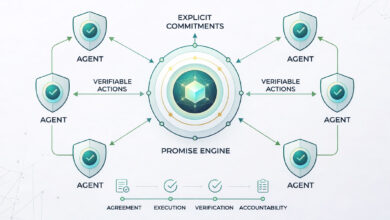
Promise Theory takes a fresh approach that autonomous systems can only make promises about their own behavior, and no agent can make promises on behalf of another. Governance isn’t about bossing them around down a hierarchy; it’s about coordinating a network of voluntary, explicit, and verifiable commitments. That shift changes a few key things.
1) From obedience to making voluntary promises
Each agent gets to say what it’s going to do. A forecasting agent promises to give a prediction within a certain confidence margin, and a remediation agent promises to only act when certain conditions are met. Because the promise comes from the agent that’s in control, it’s not just a pie-in-the-sky hope. You’re no longer governing a chain of command; you’re governing declared intentions that you can actually hold each agent to.
2) From “did it follow orders?” to “did it keep its promises?”
Once behaviour is expressed as a promise, measuring the agent’s performance gets a whole lot easier. Every action is measured against what the agent said it would do: did it stay within its confidence margin? Did the remediation actually produce the promised outcome? That’s what transparent AI decision-making really means: being able to look at a clear record of what the agent promised and what it actually delivered, rather than just being told that it’s explainable.
3) From top-down control to accountability
That actually works. When each agent stands behind its promises, you don’t have a single point of accountability. When something breaks, you don’t have to ask a monolithic controller what happened; you figure out which agent, policy or input let it down. That’s what people mean by agentic trust: not trusting that an AI is always going to be smart but trusting it because it promises things and keeps them, and keeps those promises transparent.
AI Agent Readiness Scorecard: Are Your Autonomous Systems Governable?
Promise Theory in Practice: Making Agent Behavior Checkable
In an agentic workforce , an orchestrator coordinates specialized AI agents, each with its own role and responsibility. Promise Theory lets those agents make clear commitments about what they will do, what boundaries they will follow, and when they should escalate instead of acting independently. If an agent cannot keep its promise, that failure becomes visible instead of being hidden inside a black-box workflow.
Agents also interact with applications, cloud services , networks and infrastructure – each exposing its own behavior as commitments. So a service says “I promise I’ll be available at this time”, a path says “I’ll do my best to keep latency down to this level,” and a component says “I can take on this much capacity”. An agent thinking on its feet over those promises decides on some verifiable conditions instead of just going off guesswork. Then the final link, the promise to the person who actually cares about what’s happening, maps reliability to outcomes and turns governance into a conversation that makes sense to everyone.
Applying Promise Theory to Observability and Reliability Engineering
Promise Theory helps govern AI agents by making their commitments clear and verifiable. Instead of asking whether an agent simply completed a task, teams can check whether it acted within its declared role, followed policy boundaries, and delivered the expected outcome.
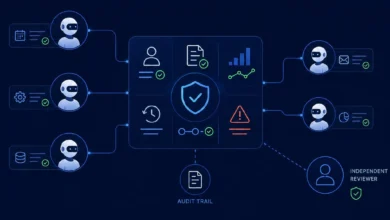
This creates a stronger foundation for agentic trust, accountability, and auditability because each decision can be traced back to the agent’s promise, policy context, and result.
How Scout Operationalizes Promise Theory for Agentic Trust
Defining promises is the easy part. The harder challenge is governing AI agents in a way that makes their commitments clear, traceable, and accountable. In agentic environments, trust cannot depend on assuming that an AI system will always behave correctly. It has to come from knowing what each agent has promised to do, what boundaries it agreed to operate within, and whether its decisions can be checked against those commitments.
Scout applies Promise Theory as a governance model for AI agents by making agent commitments explicit and verifiable. Instead of relying on command-and-control oversight, Scout helps organizations evaluate whether an agent acted within its declared role, followed the right policy constraints, and produced an outcome that aligns with its stated promise. This creates a clearer foundation for agentic trust: not blind confidence in autonomous systems, but governance based on transparent commitments, traceable decisions, and accountable outcomes.
What IT and Business Leaders Should Do Next
You don’t have to rip out your governance overnight; you just need to start treating autonomy as a promise you can check.
- Write down all the implicit promises you already make. Identify what each AI agent is expected to do, what decisions it is allowed to make, what policies it must follow, and when it should escalate
- Replace “did it run?” with “did it deliver?” Track whether each automated action kept its promise, not just whether it fired. And ask vendors for transparency if they can’t show you how an outcome got from agent logic to policy version to input, then you’re dealing with a black box, not governance.
Conclusion
Command-and-control asked machines to behave; agentic systems are too autonomous for that to work. Promise Theory meets them where they are governing the commitments they make and the outcomes you can verify, and that lets you have autonomy you can trust rather than have to police.
If you’re building trustworthy autonomous operations, see how Scout applies Promise Theory to make agentic trust measurable, how the RPI Score turns reliability into a number your business can read, and Request a demo to see how the Promise Engine verifies agent commitments in your own environment.
Frequently Asked Questions
Promise Theory is a governance approach where autonomous AI agents are understood through the commitments they make rather than the commands they receive. Each agent declares what it will do, what boundaries it will follow, and what outcomes it is responsible for supporting.
Command-and-control governance assumes that a central authority can direct every action. Promise Theory works better for AI agents because it focuses on declared commitments, policy boundaries, and verifiable outcomes instead of assuming every agent will simply follow instructions.
AI agents can make decisions and take actions with a degree of autonomy. Promise Theory helps organizations govern that autonomy by making each agent’s role, responsibilities, limits, and expected behavior clear and checkable.
Agentic trust means trusting AI agents because their commitments, decisions, and outcomes can be reviewed and verified. It is not blind trust in automation. It is trust based on transparency, traceability, and accountability.
An AI agent’s promise is a clear statement of what the agent is expected to do, what rules it must follow, and when it should escalate or stop. This makes the agent’s behavior easier to govern and evaluate.
Promise Theory supports AI governance by giving teams a practical way to define, track, and verify agent commitments. It helps show whether an agent acted within its assigned role, followed policy constraints, and produced an outcome aligned with its responsibilities.
Promise Theory improves accountability by connecting each agent’s action back to a declared commitment. When something goes wrong, teams can review which agent acted, what promise it was operating under, what policy context applied, and whether the outcome matched the intended behavior.
Scout applies Promise Theory as a governance model for AI agents. It helps organizations make agent commitments explicit, verify whether agents acted within their roles and policy boundaries, and create a clearer record of agent decisions and outcomes.
No. In this context, Promise Theory is not used for EIS, observability, infrastructure monitoring, or reliability engineering. It is used for AI agent governance, specifically to make agent behavior more transparent, traceable, and accountable.
Enterprises can measure trust by making each agent’s promises explicit, checking whether the agent stayed within its approved boundaries, reviewing decision records, and verifying whether the outcome matched the agent’s stated responsibility.

Tony Davis
Director of Agentic Solutions & Compliance