Introduction
Autonomous systems are now making real operational decisions. AI agents restart services, reroute traffic, escalate incidents, and propose remediation steps. The pace of action is faster than any human team could match. The trouble is that speed without trust creates a new kind of risk.
So how do you know whether an AI agent did the right thing? And how do you know if it will do the right thing tomorrow? And to make matters even more complicated, how do you explain that confidence to a CEO who just wants a simple answer: Is the business reliable?
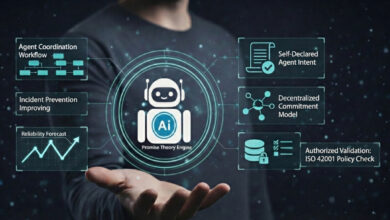
This is where Promise Theory becomes more than an academic idea. It becomes a practical framework for agentic trust, observability, and modern reliability engineering. It gives enterprises a way to define what each agent commits to, to monitor whether those commitments are kept, and to ensure decision chains are transparent and logical. Let’s unpack how it works and why it matters.
What Is Promise Theory?
Promise Theory, conceived by computer scientist Mark Burgess, is a model describing how autonomous agents cooperate and work together based on the promises they make.
Rather than just being told what to do, each agent makes promises about what it will deliver. Other components then decide whether to rely on those promises based on what evidence shows over time.
The shift from issuing orders to committing to deliver sounds like a small change. But in practice, it completely changes the way things work.
The Three Building Blocks
- Agents: The autonomous actors. These include AI agents, orchestrators, sub-agents, microservices, network devices, and humans.
- Promises: Voluntary commitments made by each agent. For example, a sub-agent might promise to spot latency spikes within 30 seconds and flag the orchestrator.
- Assessments: A continuous check to see if those promises are actually being kept
Why Promise Theory Is Just Right for Distributed, Agentic Systems
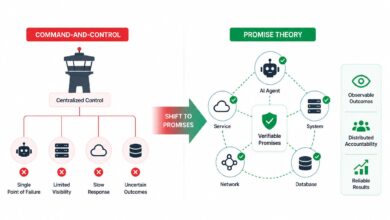
Traditional command-and-control models assume the center knows everything and dictates behavior. But modern systems don’t work like that. Cloud services, networks, and AI operate independently, often across different vendors and regions. Promise Theory accepts this reality. It regards every component as voluntary and verifiable, which is exactly how agentic AI behaves.
How to Measure Agentic Trust: A Practical IT Leader’s Guide
Why Agentic AI Needs Promise Theory
Agentic AI is not just a chatbot. It is software that plans, acts, and adapts. When agents start touching production systems, “the model said so” is not a governance answer.
Promise Theory closes that gap by making agentic behavior transparent, accountable, and verifiable.
From Black Box to Observable Commitments
An AI agent without any declared promises is like a black box. You see the outputs, but not the intent or boundaries. When that same agent makes explicit promises – “I’ll only restart pods in the staging cluster” or “I’ll escalate any RPI Score drop below 70” – you suddenly have something to check against.
Trust Built on Evidence, Not Hope
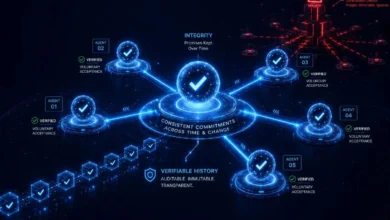
Trust is not about feelings, it’s a record of promises kept. Promise Theory lets enterprises build up that record through continuous assessment. Over time, every agent earns (or loses) a trust profile based on whether its actions matched its commitments.
Clarity Across the Agentic Workforce
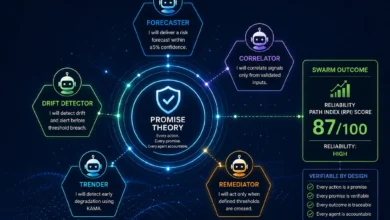
In Scout’s Agentic Workforce Framework orchestrators delegate work to sub-agents that rake over issues, spot anomalies and propose fixes. Without promises, that hierarchy becomes muddled rapidly. With promises, every agent has a clear role, a measurable output, and a defined escalation path.
Applying Promise Theory in IT Operations and Observability
Most observability stacks today are good at collecting telemetry but not at making sense of it. They pile up logs, metrics, traces, and alerts. Operations teams get drowned in noise. Promise Theory cuts through that noise by changing the question.
Instead of asking “What is the system doing?”, you ask “Is the system keeping its promises?”
Defining Promises Between Systems and Services
Each service, agent, and component declares what it will deliver. A network path promises a latency ceiling. An application promises a response time. A cloud region promises availability. An AI agent promises to triage incidents within a window.
These commitments are what Scout’s event intelligence layer keeps an eye on continuously, across hybrid cloud, on-prem, and multi-vendor stacks.
Verifying Promises with Reliability Intelligence
Verification is where most monitoring tools fall short. Telling you a CPU is at 92% is not the same as telling you whether a reliability promise has been broken. The Reliability Path Index (RPI) Score condenses thousands of signals into one unified number that maps directly to whether services are keeping their promises.
When the RPI Score drops, you don’t get a flood of alerts. You get a clear answer: which promise failed, where, and what it means for the business.
Reducing Noise by Keeping Your Eye on What Was Promised
Alert fatigue is a problem because every metric is screaming just as loudly as the next one. Promise-based monitoring only escalates when a declared commitment is at risk. The result is fewer false positives, faster triage, and meaningful MTTR reduction.
How Promise Theory Strengthens AI Governance and Accountability
AI governance is moving from policy decks into operational reality. Boards want assurance. Regulators want auditability. Customers want safety. Promise Theory provides a mechanism that satisfies all three.
Accountability Boundaries Are Explicit
Every agent has to define what it promises to do and what its limits are. For instance, an agent that says “I’ll recommend a solution, but I won’t actually do it” is fundamentally different from one that says “I will auto-fix things within these constraints”. Both are okay, as long as the line is drawn clearly and is visible and enforceable.
The trouble starts when the agent starts to change its stripes
When an agent starts acting out of character, that means it’s breaking a promise. And that’s something that can be observed and tracked. That’s the principle that Scout uses in its governance mechanisms to keep an eye on drift, cut down on hallucinations, and catch runaway automation before it gets out of hand.
Auditable AI decisions
Every action an agent takes can be linked to a specific promise and then checked against the outcome. That gives us a clear audit trail, something that’s super useful for internal reviews, executive reports, and regulatory compliance. Trust becomes something that can be measured and defended rather than just being some marketing buzzword.
How Scout Applies Promise Theory for Agentic Trust
Scout was designed with the idea that just being able to see what’s going on isn’t enough. You need an Event Intelligence Service that takes all that telemetry and turns it into plain language answers. And then you need to tie every signal back to a real business outcome. That’s just what Promise Theory does and Scout is built around that idea.
Promises mapped to the RPI Score
The RPI Score is a 13-bucket system that’s distilled from over 15 years of industry data. Each bucket represents one of the different dimensions of reliability, availability, performance, capacity, change risk, and so on. And when a promise starts to get at risk, the RPI Score reflects that right away.
Predictive Verification with Predictor, Blender, and Trender
- Predictor runs simulations to figure out how changes to operations might affect an agent’s ability to keep its promises. Teams can check whether a proposed change is likely to help or hurt before it’s even shipped.
- Blender applies real-time Six Sigma analysis to detect patterns across alarms, events, and metrics, surfacing systemic issues that put promises at risk.
- Trender uses Kaufman’s Adaptive Moving Average (KAMA) against a rolling 100-day baseline to catch early signs of degradation and broken promises in slow motion.
Trustworthy Autonomous Operations Across Hybrid Cloud
Through Scout Cloud, Scout Applications, and Scout Networks, every path through the cloud, every application call, and every network hop can be tied to a clear commitment. And that means you can run autonomous remediation with confidence, because you know exactly what the boundaries and expectations are.
Business-Context-Aware Insights
Scout takes promise verification and turns it into plain-language insights that executives can use. The CEO doesn’t need to know what Kaufman’s Adaptive Moving Average is; they just need to know if the business is reliable, whether things are on the right track, and whether it’s worth investing in.
Practical Steps for IT and Business Leaders
Adopting Promise Theory is less about new technology and more about a new operating discipline. A few practical starting points:
- Inventory the promises that already exist. SLAs, runbooks, and architectural diagrams are full of implicit commitments made explicit.
- Declare what your agents promise to do before you deploy them. Every AI agent or orchestrator should have a clear scope, a way to verify whether they’re keeping their promises, and a clear path for escalating problems.
- Make promises specific to business outcomes. A latency promise is interesting, but a latency promise that’s tied to checkout completion rate is something you can really act on.
- Keep track of trust over time. Keeping promises is a rolling score, not a one-time audit. Tools like Scout’s RPI Score make it continuous.
- Govern the agentic workforce. Orchestrators, sub-agents, and human operators all need clear roles and visible commitments.
Conclusion
The companies that get ahead with agentic AI are not going to be the ones who just deploy lots of agents; they’re going to be the ones who build reliable agents. And Promise Theory gives you the language, the structure and the model to make that happen.
Scout brings the intelligence layer to make it real reliability scores tied to promises, forecasting tied to investments, and plain-language insights tied to business decisions.
If you’re scaling up autonomous operations and need a way to measure trust explore how Scout applies Promise Theory for agentic trust or Request a demo to see how the RPI Score turns your environment into a single, business-friendly signal for reliability.
Frequently Asked Questions
Promise Theory is a model created by computer scientist Mark Burgess. It explains how autonomous components work together by making promises to each other & then being continuously checked on to see if they keep them up to scratch. This has been widely adopted in distributed systems, in IT operations & is now being looked at for agentic AI.
With agentic AI, which is software that plans & acts on its own, Promise Theory helps define each agent’s scope & what it’s promising to do. This makes its behaviour much clearer, accountable and easy to see whether it’s working as promised, rather than being just a mystery.
Agentic trust is when an organisation is confident in the autonomous systems it’s using because it can see they’re keeping their promises. It’s built up over time by verifying things, not just assumed when an AI is first turned on.
With autonomous operations making decisions much faster than any human can keep an eye on, Promise Theory provides a structure that lets you set boundaries, keep an eye on commitments & know if those agents stray from what they said they’d do.
Instead of just being swamped with all sorts of metrics without any meaning, Promise Theory lets you focus on whether the promises being made are actually being met. This gets rid of a lot of unnecessary noise & makes it so much clearer what’s going on.
It’s very useful in making sure that every AI agent is doing what it’s supposed to you can see exactly what its scope is & what it’s doing and that makes it much easier to keep an eye on things internally, report to execs & comply with regulations.
A system promise is just a declared commitment by a service, an app, a network or an AI agent maybe something like an uptime target, a latency limit or a promise to respond to something within a certain time. These commitments can then be checked on to see if they’re being kept.
Scout puts Promise Theory into its Event Intelligence Service, linking up promised commitments with its RPI Score, agentic workforce framework & analysis engines so businesses can check if systems & agents are living up to their reliability promises.
The Reliability Path Index takes all those metrics & squishes them down to 13 reliability categories. Each category is linked to a particular type of promise, making the RPI Score a nice, clear & business-friendly measure of whether promises are being kept.
You do it by making each agent promise what it’s going to do, checking if it keeps to that promise & tracking how it does over time. Trust then becomes a solid, evidence-based score, not just a guess which is exactly what Scout’s reliability intelligence does.

Tony Davis
Director of Agentic Solutions & Compliance