Introduction
You’ve got a hybrid cloud generating millions of events every single day. Your team’s then pestered by endless alerts and buried somewhere within that mountain of noise is that one really important signal, the one you’d miss if you didn’t spot it the one that turns into a 3 a.m. panic call.
That’s the core issue with how most IT monitoring is set up: it tells you something’s broken but doesn’t give you any clue as to what triggered it, what else it’ll affect, or how to stop it from happening again.
An Event Intelligence System gets around this by correlating all your events be that within on-prem infrastructure, cloud services or app layers and transforms raw telemetry into something you can actually do something with, and ties that directly to a measurable IT reliability score. Here’s what that actually looks like, and why it matters in modern hybrid cloud environments.
What Is an Event Intelligence System?
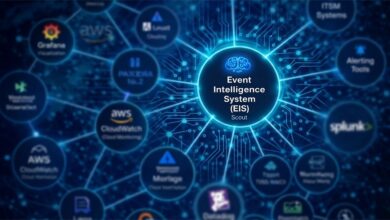
A real Event Intelligence System is an AI-powered platform that ingests, correlates and prioritizes operational events from your entire IT environment – network, applications, servers, cloud services and logs in real time.
Unlike traditional monitoring tools that just fire off random alerts, an EIS groups related events, maps dependencies out and gives you a single, neat incident with a clear root cause. According to Gartner an AI platform that uses event intelligence can reduce alert noise by up to 90% freeing SRE and DevOps teams to focus on what actually counts.
So what does a good EIS actually deliver? Well three things:
- signal through the noise: thousands of alerts condensed down into a handful of actual incidents you can do something about
- context over symptoms: root cause is identified right across dependency chains, not just that annoying error on the surface
- prediction over reaction: anomalies are flagged 15-30 minutes before they even start causing problems for users
Why Event Intelligence is a Must Have for Hybrid Cloud Environments
In 2025 your enterprise is probably running workloads across AWS, Azure, on-prem data centres, SaaS platforms and containerised microservices all at the same time. Monitoring each environment with separate tools is a recipe for disaster, and creates blind spots.
When an application starts slowing down it can be any number of things a misconfigured Kubernetes pod, a saturated database connection pool or a network bottleneck in a completely different infrastructure tier. A traditional monitoring dashboard shows each symptom independently while an EIS platform shows the actual causal chain.
This isn’t just a matter of principles the costs are real. IDC research shows that infrastructure failure costs large enterprises an average of $250,000 per hour of downtime. In hybrid cloud environments where complexity multiplies the risk, proactive IT monitoring is no longer a choice, it’s a competitive necessity.
Scout’s Event Intelligence Platform is built specifically for dealing with this kind of complexity. It processes millions of events every second across multi-cloud environments without even breaking a sweat – giving IT teams a unified operational view from one single dashboard.
How Event Intelligence Reduces Alert Fatigue
Alert fatigue is probably one of the most damaging and underreported problems in IT ops. When teams start getting hundreds of alerts every day they begin to filter them on instinct rather than reason critical signals get missed, response times go down and burn out becomes a major issue.
AI event correlation platforms get around this in three main ways:
- event deduplication – identical alerts from different tools are merged into a single incident
- topology-aware grouping – related alerts across dependent services are grouped, not fired off separately
- noise suppression – machine learning filters out low-priority repetitive signals based on historical patterns
Scout’s EIS reduces alert volume by up to 85% You can check out the platform’s AI-powered insights to see how it handles anomaly detection and intelligent alert orchestration.
IT Reliability Scoring – A New Metric for Teams
Uptime percentages and incident counts tell you what’s gone wrong. They don’t give you any idea of how healthy your infrastructure is in the present moment, or how it’s trending.
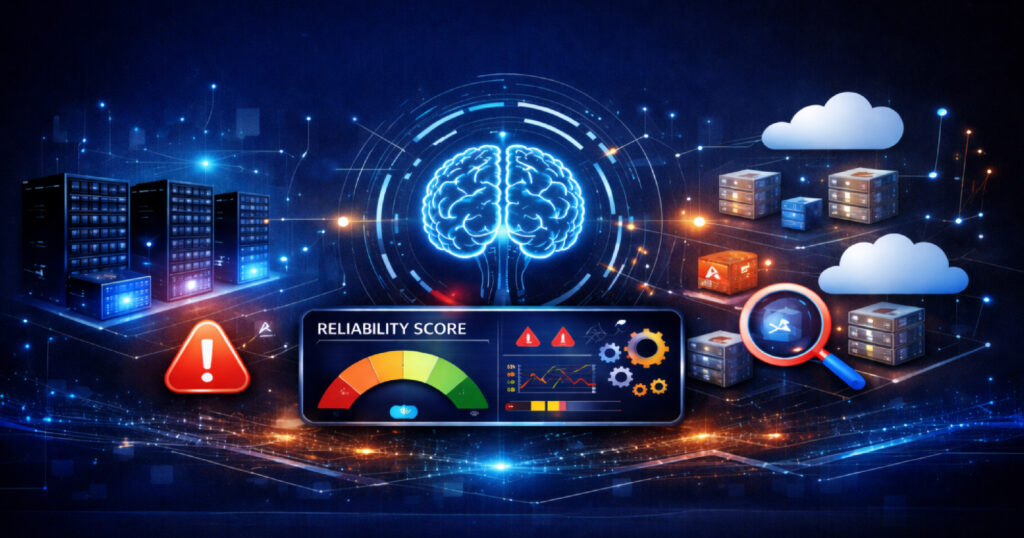
IT reliability scoring flips this around. It aggregates all your key performance indicators – latency, OS errors, rates, application lag, syslog, and business impact – and gives you a single composite metric that both senior management and engineers can act on.
Scout’s Reliability Path Index (RPI) is the industry’s first holistic reliability score built on Promise Theory a mathematical framework originally developed for distributed systems. It calculates reliability across all your infrastructure, apps, networks and user experience at the same time, giving teams an early warning system that traditional KPI dashboards just can’t provide.
The RPI isn’t just a number – it’s a directional signal. When it drops, something upstream is degrading. When it holds steady, your infrastructure is performing to expectations.
The Future of IT Operations: From Monitoring to Autonomous Systems
Event Intelligence vs Traditional Monitoring
| Capability | Traditional Monitoring | Event Intelligence (Scout) |
| Alert volume | 200+ per day (85% noise) | 15–20 actionable/day |
| Root cause speed | Hours of manual work | Under 10 minutes with AI |
| Cross-domain view | Siloed per tool | Unified hybrid cloud view |
| Predictive detection | Reactive only | 15–30 min ahead of failure |
| Reliability scoring | Not available | Reliability Path Index (RPI) |
Core Capabilities to Look For in an EIS Platform
Not all event intelligence platforms are equal. When you’re evaluating options, these are the capabilities that separate a genuine platform from a rebranded monitoring dashboard:
- They automate root cause analysis using a visual dependency graph
- Predict incidents at least 15 minutes before they happen
- Business impact mapping – turning technical events into revenue and SLA risk
- A single view of all domains in observability – no more switching between screens
- Intelligent alert handling that deduplicates and routes to the right person
Scout’s platform does all of this natively. It uses an Agentic AI Workforce built on a swarm intelligence pattern like a beehive to deploy agents for correlation, drift detection, prediction and summarisation in parallel. Not one after another
Who Benefits Most from Event Intelligence?
Event intelligence platforms deliver the strongest ROI for:
- SRE teams – way faster time to repair and fewer hours spent wading through incidents manually
- DevOps teams – warning signals weeks earlier during deployments and release cycles
- MSPs – automated SLA reporting for multi-tenant monitoring across client environments
- Enterprise IT operations – one place to see your whole infrastructure, rather than having to mash up lots of different tools
Conclusion
Hybrid cloud monitoring is only as good as the intelligence behind it. Raw events without correlation are just noise. Alerts without context are just overhead. And uptime metrics without a reliability score are just backward-looking data.
An Event Intelligence System closes all three gaps simultaneously, reducing alert fatigue, accelerating root cause analysis, and giving your team a forward-looking reliability score that reflects the true health of your infrastructure.
If your monitoring setup still treats every alert as an independent signal, it’s time to move to something smarter.
Explore how Scout’s Event Intelligence Platform brings AI-driven correlation, predictive insights, and reliability scoring into a single unified view.
Frequently Asked Questions
An Event Intelligence System (EIS) is an AI-powered platform that collects, correlates, and prioritizes events from across your entire IT infrastructure, including applications, cloud services, network, and logs in real time. Unlike traditional monitoring tools that generate isolated alerts, an EIS groups related signals, identifies root causes automatically, and surfaces only the incidents that require human attention.
An EIS uses AI-driven event correlation and noise suppression to group related alerts, eliminate duplicates, and filter low-priority signals. Platforms like Scout reduce daily alert volume by up to 85%, so operations teams focus on the 15–20 incidents that matter rather than sifting through hundreds of false positives.
IT reliability scoring is a composite metric that aggregates performance, availability, error rates, and SLA adherence into a single score representing the true health of your infrastructure. Scout’s Reliability Path Index (RPI) is the industry’s first cross-stack reliability score, giving both engineers and executives a forward-looking indicator of infrastructure health.
Traditional monitoring fires individual alerts per system or metric. Event intelligence correlates signals across all infrastructure domains, maps dependencies, and provides causal context — not just symptoms. The result is faster root cause analysis, fewer false positives, and predictive incident detection instead of reactive response.
AIOps event intelligence combines artificial intelligence and machine learning with IT operations management to automatically process and prioritize operational events at scale. It enables capabilities like predictive anomaly detection, automated root cause analysis, and intelligent alert orchestration that would be impossible with manual processes.
In hybrid cloud environments, an EIS ingests telemetry from on-premises infrastructure, public cloud services (AWS, Azure, GCP), containerized workloads, and SaaS platforms simultaneously. It normalizes data across these sources, maps cross-environment dependencies, and surfaces unified incidents, eliminating the siloed visibility that causes blind spots in multi-cloud setups.
Most organizations see measurable ROI within the first month of deployment. Scout customers report MTTR reductions of 67–75% and alert volume drops of 80–85% within 30 days. Preventing even one major incident per quarter typically offsets the platform’s annual cost entirely.
Not necessarily and the best EIS platforms don’t require it. Scout integrates with existing tools, acting as an intelligence layer above them. You can adopt event intelligence incrementally without ripping out your current toolchain.
Predictive incident detection uses machine learning models trained on historical infrastructure patterns to identify anomalies before they escalate into user-facing incidents. Scout’s EIS forecasts potential failures 15–30 minutes in advance, giving operations teams time to intervene proactively rather than respond reactively.
SRE teams, DevOps engineers, MSPs, and enterprise IT operations teams all benefit significantly. SREs gain faster MTTR and fewer manual correlation tasks. DevOps teams get earlier deployment warning signals. MSPs benefit from multi-tenant dashboards and automated SLA reporting. Enterprise IT gains unified visibility across a complex hybrid cloud infrastructure.

Tony Davis
Director of Agentic Solutions & Compliance