Introduction
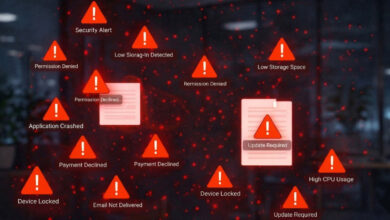
You get 300 alerts overnight. By morning, your team’s barely scratched the surface. The rest? Just noise. It’s a reality that’s all too familiar for IT operations teams, and it’s exactly why the debate around Event Intelligence Systems (EIS) and AIOps platforms has really taken off in 2026.
Gartner’s 2024 rebrand of AIOps to Event Intelligence Solutions marked a turning point in how the industry thinks about AI in IT operations. But with this change came a whole bunch of questions: What’s actually changed? Which approach is going to deliver more value? And what’s the right choice for your team?
Let’s dive into it and see what the experts have to say.
What is an AIOps Platform?
AIOps, or Artificial Intelligence for IT Operations, started out as a catch-all term for using machine learning to make IT workflows better. These platforms would take in all sorts of data from across the infrastructure, apply some fancy math, and then try to come up with some insights that would make life easier for the humans.
Sounds great on paper, but in reality, many teams found that AIOps platforms were tough to get right, slow to deliver results, and prone to generating even more noise than they were trying to solve. The tools were clever, but they just weren’t focused enough on the things that really mattered.
What is an Event Intelligence System?
Event intelligence systems take a different approach. Instead of trying to solve everything at once, EIS platforms focus on one core thing: making sense of events in real time so you can respond to incidents faster and smarter.
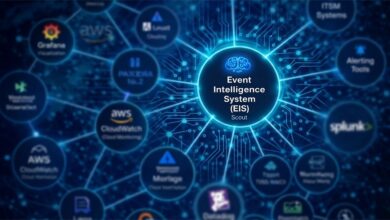
An EIS takes in alerts from all your monitoring tools, weaves together related signals, silences the noise, and gives you a clear picture of what’s actually going on and what to do about it.
According to Gartner’s 2025 Market Guide for Event Intelligence Solutions, there are three key things that EIS platforms should be able to do:
- Help your team make better, faster decisions
- Speed up the time between spotting a problem and sorting it out
- Automate as much of the remediation process as possible using agentic AI
That’s a pretty big change from the way AIOps platforms used to work, and it’s why platforms like Scout’s Event Intelligence Platform are really starting to make some noise.
A step-by-step scorecard to evaluate whether your IT ops stack is ready to move from legacy AIOps to Event Intelligence in 2026.
EIS vs AIOps:
| Category | AIOps Platforms | Event Intelligence Systems |
| Primary Focus | Broad ML-driven IT automation | Alert correlation & noise reduction |
| Gartner Category | Renamed to EIS (2024) | Current Gartner standard (2025-2026) |
| Alert Handling | Reactive; post-event analysis | Proactive; correlation before impact |
| Root Cause Analysis | Broad; often requires tuning | Targeted; fast, automated RCA |
| AI Approach | General ML models | Governed, domain-specific AI agents |
| Agentic AI Support | Emerging, limited | Native; built for agentic workflows |
| Best For | Large enterprises, multi-tool stack | SRE, DevOps, MSP teams |
| MTTR Impact | Moderate reduction | Up to 67% MTTR reduction |
What Went Wrong with AIOps?
The AIOps category expanded too fast, too broadly. By 2023, dozens of vendors from full-stack observability platforms to niche log analyzers were all calling themselves AIOps tools. Buyers couldn’t differentiate.
More critically, many AIOps implementations failed to reduce alert fatigue or improve MTTR in meaningful ways. Teams invested heavily and still ended up firefighting.
Gartner’s reframe to Event Intelligence Solutions was, in part, an acknowledgment of this: IT teams need platforms that are precise about what they do, not tools that promise to solve all of IT operations through general-purpose AI.
The Rise of Agentic AI in Event Intelligence
2026 is different from the AIOps era because of agentic AI. Earlier EIS and AIOps tools just observed and recommended. Modern event intelligence platforms with agentic AI don’t just watch your infrastructure; they act on it. Scout is built around this principle; it is the only platform that combines event intelligence with a governed AI. workforce based on promise theory a formal model of how services can commit to behavior & how those commitments can be monitored & enforced autonomously.
What does this look like in practice?
- An AI agent picks up on a latency spike on a payment gateway
- It correlates this event with a memory ceiling on a downstream API
- It starts a remediation workflow and doesn’t wake up your on-call engineer in the process
- It logs the decision, the evidence & the outcome , for governance review
This isn’t just AIOps (though you might see it compared to it); this is autonomous IT operations, and it’s the direction the entire EIS category is moving
Key Differences That Actually Matter for Your Team
1. Alert Noise Reduction
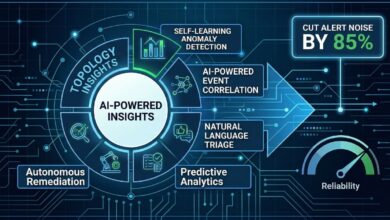
AIOps platforms reduce noise. EIS platforms are engineered specifically for it. Scout customers report an 85% reduction in alert volume not by ignoring alerts, but by correlating them into coherent incident narratives that teams can actually act on.
2. Root Cause Analysis Speed
Traditional AIOps tools require significant tuning before RCA becomes reliable. EIS platforms, especially those with agentic AI, surface root causes in under 10 minutes by mapping dependencies across your entire stack automatically.
3. Integration Flexibility
Both EIS and AIOps platforms support integrations with Prometheus, Grafana, Datadog, and cloud providers. But EIS platforms are designed as correlation and intelligence layers; they sit above your existing tools, not instead of them.
4. Business Impact Alignment
One of the biggest gaps in legacy AIOps tools: they spoke the language of infrastructure, not business outcomes. Modern EIS platforms like Scout translate technical signals into business risk so your CTO and your SRE team are looking at the same picture.
Who Should Use an EIS Platform in 2026?
Event intelligence systems are a good fit if:
- Your team is drowning in alert noise from multiple monitoring tools
- You need to get faster M.T.T.R without having to expand your on-call rotation
- You manage complex hybrid or multicloud environments
- You operate in regulated industries where audit trails & governance matter
- You want to move towards autonomous IT operations with agentic AI
AIOps-style broad automation may still have a place in very large enterprises with a lot of old infrastructure, but for DevOps teams, SRE teams, MSPs, and cloud-first organizations, EIS delivers faster & more measurable results.
How Scout Leads the EIS Category
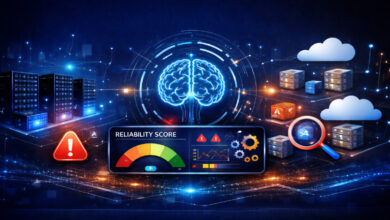
Scout was built from the ground up for the era of Event Intelligence. The platform combines AI-powered anomaly detection, automated root cause analysis & a Reliability Path Index (RPI), a proprietary metric that gives every stakeholder a single clear view of infrastructure health.
Unlike traditional AIOps platforms, Scout’s AI-powered insights don’t just spit out recommendations; the governed AI workforce actually acts on them autonomously, accountably & within the rules your team defines.
The results are pretty clear: our customers see a 67% reduction in M.T.T.R., 85% fewer alerts & up to 92% of outages prevented before users are ever affected.
Whether you’re an MSP managing hundreds of client environments, a FinOps team optimizing cloud spend, or a healthcare IT team running HIPAA-compliant infrastructure, Scout’s Event Intelligence Platform was built with your reality in mind.
Conclusion: The Future Is Event Intelligence
The AIOps vs EIS debate isn’t really about labels; it’s about whether your it operations platform is built for the speed & complexity of 2024 or for the it landscape of 2018.
Event intelligence systems win on focus, precision & measurable outcomes. Add agentic AI to the mix and you have a platform that doesn’t just respond to incidents; it prevents them.
If you’re still relying on broad-brush AIOps tools that generate noise & require constant tuning, it’s time to rethink your stack.
Ready to see what event intelligence actually looks like? Book a Demo with Scout and see how the platform can reduce your M.T.T.R, eliminate alert fatigue, & bring autonomous reliability to your infrastructure.
Frequently Asked Questions
AIOps is a broad category of AI-driven IT automation tools. Event Intelligence Systems (EIS) are a refined evolution focused specifically on alert correlation, noise reduction, and intelligent incident response. Gartner officially rebranded AIOps to EIS in 2024.
Gartner found that the AIOps label was too broad and created confusion. EIS better describes the actual function using AI to make sense of events, reduce noise, and drive faster incident resolution.
In 2026, the best platforms combine event correlation, noise reduction, automated root cause analysis, and agentic AI-driven remediation. Scout stands out by combining event intelligence with a governed AI workforce and Reliability Path Index (RPI), helping teams reduce alert fatigue and improve MTTR.
EIS correlates signals from multiple monitoring tools, suppresses redundant alerts, and surfaces only actionable incidents reducing alert noise by up to 80–85%.
Not dead evolved. AIOps as a concept lives on within EIS. The term AIOps is still used, but Gartner’s official EIS classification has become the industry standard.
EIS stands for Event Intelligence System (or Event Intelligence Solutions). It refers to AI-powered platforms that manage, correlate, and act on operational events across IT infrastructure.
Agentic AI takes EIS a step further instead of just correlating events, AI agents autonomously investigate root causes, recommend fixes, and even trigger remediation actions without human intervention.
For 2026, EIS is the more focused and effective choice for most IT teams. AIOps tools cast a wide net; EIS platforms deliver precision faster RCA, less noise, and measurable MTTR reduction.
By automating alert correlation and root cause analysis, EIS eliminates manual investigation steps cutting mean time to resolution by as much as 67%, according to early adopter benchmarks.
Scout is the only platform built on Promise Theory with a governed AI workforce and Reliability Path Index (RPI). It goes beyond observation, actively operating your infrastructure and preventing outages before they happen.

Tony Davis
Director of Agentic Solutions & Compliance