Introduction
Your hybrid cloud is growing and so is the noise. Teams are getting buried under thousands of alerts every single day and most of them are likely false positives. Meanwhile, the real incidents go unnoticed until a customer complains.
That’s the gap an Event Intelligence System is designed to close.
In a hybrid cloud environment where workloads span on-prem servers, AWS, Azure, GCP, and everything in between traditional monitoring tools are just not up to the task. You need more than just dashboards. You need a brain-intelligent event correlation, predictive detection, and automated response.
This guide breaks down what an Event Intelligence Platform does, why it matters for hybrid IT infrastructure monitoring, and what you should be looking for in one.
What Exactly is an Event Intelligence System?
An Event Intelligence System (EIS) is an AI-powered layer that sits on top of your existing monitoring setup. It takes in raw signals – metrics, logs, traces, alerts – from every layer of your infrastructure and turns that data into actionable insights that you can actually use.
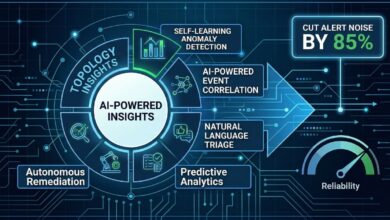
Unlike traditional monitoring, which just fires an alert for every threshold breach, an EIS uses machine learning and intelligent event correlation to:
- Group related events into one single, meaningful incident
- Automatically suppress redundant or noisy alerts that are wasting your time
- Identify the root cause of a problem – right across your infrastructure layers, from server to application
- Predict issues before they escalate into outages that can bring your business to a grinding halt
Result? Fewer alerts. Better signal quality. Faster resolution times.
Hybrid Cloud Monitoring Survival Kit: Cut Alert Noise by 80% in 30 Days
Why Hybrid Cloud Monitoring Demands More
According to Gartner, over 85% of enterprises will be running on some sort of hybrid cloud mode by 2025. And managing that infrastructure across multiple environments comes with its own unique set of challenges.
| Challenge | Impact |
| Fragmented visibility | You can’t see what’s going on in all your different environments |
| Alert overload | You’re drowning in a sea of false positive alerts |
| Slow root cause analysis | MTTR stretches on for hours |
| Multi-cloud complexity | Each cloud provider has its own way of doing things |
How Event Intelligence Works in Hybrid Environments
A modern Event Intelligence Platform works across five main stages:
- Data Ingestion: It collects metrics, logs, and traces from on-prem, multi-cloud, and edge sources into one unified stream.
- Intelligent Event Correlation: It groups thousands of raw events into a small number of actionable incidents using AI-driven pattern recognition.
- Anomaly Detection: Machine learning models detect when something is going outside of what is normal – without you having to set up any manual thresholds.
- Root Cause Analysis: The system pinpoints exactly where the problem is coming from, whether it’s a misconfigured VM, a saturated network link, or a failing microservice.
- Automated Incident Response: It triggers runbooks, notifies the right team, or even auto-remediates based on what you’ve predefined.
Key Benefits of AI-Powered Event Intelligence
Organizations that deploy an AI event correlation platform for multi-cloud environments are consistently seeing real results. Here are the kinds of benefits you can expect:
- 80% reduction in alert noise – your teams can focus on the real issues
- 67% faster MTTR – AI root cause analysis puts an end to hours of manual investigation
- Proactive outage prevention – predictive event monitoring catches problems before they cause any harm
- Unified visibility – one pane of glass for on-prem, AWS, Azure and GCP
- Better team alignment – SREs, DevOps and business stakeholders all share the same reliability score
The shift from firefighting to proactive prevention isn’t just about ops it’s also about protecting revenue.
What to Look for in an Event Intelligence Platform
Not all event monitoring tools are up to the task of handling hybrid complexity. When evaluating a platform, prioritize these key capabilities:
- Native hybrid support: It has to be able to monitor both cloud-native and legacy on-prem workloads, without needing separate agents
- AI-driven anomaly detection: Threshold-based alerts are not enough; you need ML models that learn your environment
- Topology mapping: Real-time dependency maps that keep up with your infrastructure as it changes
- Low-noise alerting: It’s got built-in alert deduplication and correlation, not something that you have to bolt on
- Open integrations: It needs to be able to connect with your existing stack, including Prometheus, Grafana, PagerDuty, ServiceNow, and all the rest
- Compliance-ready reporting: Audit trails and SLA dashboards for enterprises that are in regulated industries
Scout’s Event Intelligence System: Built for Hybrid Cloud
Scout’s Event Intelligence System (EIS) was built from the ground up for the realities of modern hybrid IT infrastructure monitoring. It doesn’t just collect signals, it understands them. It’s powered by a Governed Agentic AI workforce built on the principles of Promise Theory and Scout goes far beyond just observing. It actively operates your infrastructure, correlating events, filtering out the noise, tracing back to the root of the problem, and kicking off automated fixes right on the spot.
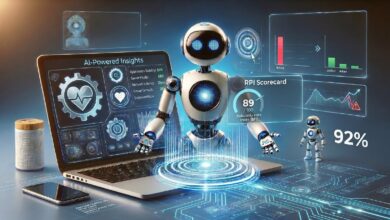
At the very heart of the platform is the Reliability Path Index (RPI), a proprietary scoring system that gives every team a single, business-friendly number to keep an eye on infrastructure health no more digging through seventeen different dashboards for a glimpse of what’s going on. One number. The whole picture.
Scout integrates with your existing toolkit, so you don’t have to junk the systems you’ve already got. You get intelligent AI-driven observability layered right on top of what you’re already using.
Whether you’re an SRE team managing to keep service uptime at 99.9% or, a DevOps team drowning in alert overload or an enterprise with multiple cloud accounts to keep track of, Scout’s event intelligence platform adjusts to fit your environment.
Conclusion
Hybrid cloud environments are only going to get more complicated. There will be a growing number of services, signals and dependencies to deal with. The teams that stay ahead of the game won’t be the ones with the most monitoring tools on the shelf – they’ll be the ones who have an intelligent event correlation layer sitting on top of all their other tools.
An Event Intelligence System is no longer just a nice-to-have.t’s the foundation for resilient, proactive observability of the whole hybrid cloud.
Ready to see how Scout’s Event Intelligence Platform stacks up in your environment?
Book a Free Demo | ScoutAgentics.com | Explore the Event Intelligence System
Frequently Asked Questions
An Event Intelligence System (EIS) is an AI-powered platform that sucks in raw monitoring signals – metrics, logs, traces and alerts – from all over your infrastructure and turns them into actionable incidents using automated event correlation and anomaly detection.
Traditional monitoring fires off alerts when a metric crosses a certain threshold. Event intelligence uses machine learning to correlate related signals, suppress redundant alerts, detect anomalies without needing manual thresholds, and identify root causes – delivering fewer smarter and more actionable notifications.
Hybrid cloud environments are giant soup bowls of on-prem servers and multiple cloud providers – generating thousands of signals from different formats and tools. An event intelligence platform brings all that data together, reduces the noise and gives full stack visibility- something siloed monitoring tools can’t even touch.
Intelligent event correlation is the process of grouping thousands of individual monitoring events into a handful of meaningful incidents using AI and topology mapping. Instead of getting 500 alerts your team gets 10 high priority incidents with root cause context.
Yes. AI-powered event monitoring platforms typically reduce alert volume by 75-85% by deduplicating, correlating and filtering out the noise. Teams get only actionable alerts – which directly cuts down on alert fatigue and improves incident response times.
AIOps is the bigger category that encompasses event intelligence, anomaly detection, root cause analysis and automated remediation. An Event Intelligence Platform is a core part of an AIOps strategy.
Scout’s EIS sucks in signals from on-prem and multi cloud environments, applies AI driven correlation and anomaly detection, generates root cause insights – all under the Reliability Path Index (RPI) scoring system.
The Reliability Path Index (RPI) is Scout’s proprietary metric that consolidates infrastructure health data into a single business friendly score. It lets IT, DevOps and executive teams get a clear picture of service reliability without digging through a load of multiple dashboards.
Yes. Scout integrates with so you can add event intelligence on top of your existing monitoring setup without replacing anything.
Scout gets up & runs fast. In fact, most teams are good to go in under 5 minutes. No need to waste precious time fiddling with complex config or trying to rip & replace what you’ve got already. We make it easy to get started and there’s even a no-strings-attached free RPI assessment on offer , so you can right away see the potential value that’s hidden in your existing infrastructure data.

Tony Davis
Director of Agentic Solutions & Compliance