Introduction
To begin with, there’s a number out there that’s going to make any network operations center (NOC) manager sit up: Gartner predicts that by 2026, a whopping 60% of network operations personnel will be relying on generative AI for day-to-day management, a massive jump from the less than 5% of early 2024. Clearly, that’s not a gradual adoption curve; that’s a cliff. And honestly, it’s about time. After all, NOC teams have been drowning in alert fatigue for years, and I mean years. In fact, a typical enterprise network generates anywhere between 50,000 and 200,000 raw alerts per month. Unfortunately, most of them are pure noise. Meanwhile, the handful that actually do matter get lost in the avalanche, and before you know it, customers are already on the phone.
Fortunately, generative AI turns the equation on its head, not by throwing another dashboard or another layer of rules at the problem, but by giving your event intelligence system the ability to read, reason, summarise, and act in plain English, in real time, at machine speed. Ultimately, that’s what happens when AIOps stops being some buzzword and actually becomes a genuine operational partner for your NOC.
At Scout, we’ve built our platform around exactly this shift: a governed AI workforce that doesn’t just flag problems, it investigates, explains, and resolves them. With that in mind, here’s how GenAI is reshaping event intelligence for NOC teams.
Access the GenAI Implementation Blueprint for Modern NOCs
Why NOC Teams Are Hitting a Wall And Why GenAI Is the Answer
Traditional NOC monitoring was great for a simpler era; however, it’s not great for the one we’re living in. Sure, those static thresholds, manual triage, siloed tools, and L1 operators scrolling through walls of red alerts worked just fine back when you had a few dozen servers in a rack. But it just plain collapses when you’re running hundreds of microservices across hybrid cloud, containers, edge nodes, and third-party APIs.
In truth, the problems haven’t really changed in a decade; they’ve just gotten a lot louder:
- Alert noise: First, 85% of alerts are pure dead weight. As a result, engineers are wasting up to 30% of their time on false positives (Gartner).
- Slow triage: Next, L1 operators just don’t have the context to resolve incidents, so they end up escalating. Consequently, the mean time to resolution (MTTR) stretches out to hours and hours.
- Talent constraints: On top of that, you can’t just hire an endless supply of engineers to stare at dashboards 24/7. The math just doesn’t work out.
- Tool sprawl: Finally, the average enterprise NOC is juggling 5–8 disconnected monitoring platforms now. Therefore, context lives everywhere and nowhere at the same time.
Fortunately, GenAI isn’t just a nice-to-have that eases these problems; it structurally eliminates them by giving machines the ability to understand events the way a senior engineer would, but at a scale no human team can match.
How Generative AI Transforms Event Intelligence in the NOC
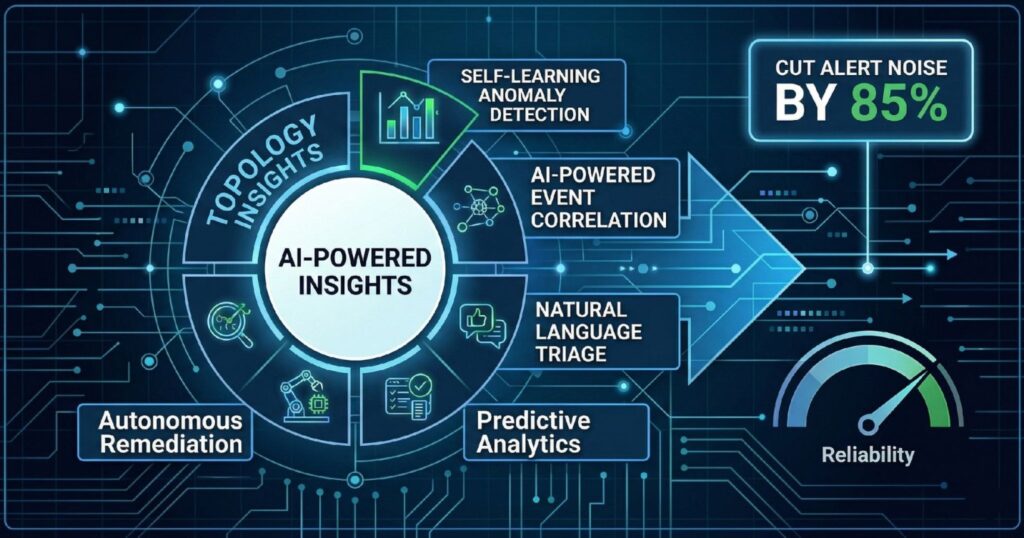
1. AI-Powered Anomaly Detection That Replaces Static Thresholds
Look at all those static thresholds CPU above 90%, disk below 10%. Frankly, they just generate noise on an industrial scale. In contrast, GenAI-powered AI anomaly detection gets rid of all that. Specifically, the system studies your environment’s normal behaviour patterns and flags deviations that your static rules would miss: a slow memory leak building over days, an unusual API latency shift at 3 am, or a subtle change in transaction ratios signaling an upstream failure.
Better still, Scout’s AI-Powered Insights engine learns your specific environment from day one and automatically adjusts sensitivity without needing manual configuration.
2. Natural Language Incident Triage That Empowers L1 Operators
Now, this is where GenAI really earns its keep in the NOC. Instead of L1 operators manually trawling through logs and runbooks, GenAI does AI incident triage by generating plain-English summaries of what’s happening, what’s likely causing it, and what to do about it. In other words, think of it as instantly handing every L1 engineer the contextual awareness of a senior SRE.
The result? Fewer unnecessary escalations to L2 and L3, faster incident management, and L1 teams that actually enjoy their shifts instead of drowning in noise.
3. AI-Powered Event Correlation That Cuts Through the Noise
Traditionally, legacy event correlation groups alerts by rules or basic ML patterns. However, GenAI takes it a few steps further; it understands dependencies, reads change logs, cross-references topology data, and delivers correlated incidents with full context attached. In other words, not just “these alerts are related,” but “here’s the root cause, here’s what changed, and here’s the blast radius.”
Notably, Scout’s approach is built on Promise Theory modelling the explicit obligations between every component in your stack. Therefore, when a promise is broken, the system traces it down deterministically to its origin. As a result, no guesswork, no statistical hand-waving.
See how Promise Theory powers deterministic root cause analysis that those correlation-based tools just can’t deliver.
4. Predictive Analytics That Stop Outages Before They Happen
Above all, the most expensive incident is the thing that your customers notice first. Fortunately, continuous predictive analytics from GenAI are always on the job using the patterns it’s learned from the past, the capacity trends it’s been following, and real-time signals to raise the alarm on risks before they have a chance to escalate. For example, a disk filling up at 2% a day? We’d tell you about that three weeks ahead of time. Likewise, a deployment that’s causing a latency regression? You’d hear about that in minutes.
Consequently, Scout customers report that they’re able to prevent up to 92% of potential outages by spotting issues proactively, catching problems at the “anomaly” stage before they become “incidents.”
5. Autonomously Fixing Problems Before They Become Incidents
Just spotting problems isn’t enough; after all, detection without action is just a fancy way to watch things go wrong. Instead, GenAI closes the loop with incident response automation, which means automated agents can restart services, scale up the infrastructure, roll back a deployment, and even trigger ITSM workflows all without needing a human to intervene.
Equally important, every single action is governed: it’s all set up with predefined rules, logged carefully with a full audit trail, and you’re even able to reverse any action with just one click. Ultimately, that’s the difference between NOC automation that just runs on autopilot and autonomy that works with discipline.
NOC Operations Before and After GenAI
| Metric | Before GenAI | With Scout |
| Issue Detection | 2–4 hours after the user reports | 3–5 minutes before impact |
| Root Cause Analysis | 3–6 hours manual investigation | Under 10 minutes with AI |
| Daily Alert Volume | 200+ alerts, 85% noise | 15–20 actionable incidents |
Mean Time to Resolution | 4–6 hours average | 45–90 minutes average |
| L1 Escalation Rate | 70%+ escalated to L2/L3 | Under 30% with GenAI triage |
| Outage Prevention | Reactive 0% prevented | Up to 92% prevented proactively |
For teams managing multi-tenant environments, our MSP solution delivers these gains across hundreds of client infrastructures simultaneously.
Measuring It All Up: The Reliability Path Index
Beyond fixing problems, GenAI changes the way that NOC teams measure and talk about reliability. After all, most teams have to juggle a dozen different dashboards, each one showing just a little piece of the picture. So when the ops manager asks, “How healthy are we?” they get a different answer from every single screen.
Fortunately, Scout’s Reliability Path Index (RPI) boils all that down to a single score that shows how healthy your infrastructure is in real time. Specifically, it takes into account latency, system response times, server health, OS stability, log quality, and user experience degradation. As a result, for NOC teams, it’s a handy compass to help them figure out what to do. Meanwhile, for the board, it’s a number they can actually understand.
Getting Your NOC GenAI-Ready
Importantly, you don’t have to rip out your entire monitoring stack to start using GenAI-powered event intelligence. In fact, Scout integrates with over 300 different observability platforms that you’re probably already using. Better yet, getting set up only takes 5 minutes, and the platform starts learning about your environment right away. Consequently, most NOC teams see a noticeable reduction in noise within the first week.
Additionally, the platform is SOC 2 Type II certified, HIPAA-compliant, and specifically built to handle the SLA monitoring and compliance needs of industries like healthcare, financial services, and big enterprise. Above all, every single AI action is fully auditable your data stays locked down.
Conclusion
GenAI is doing for the NOC what the NOC was originally built to do for the network: making sense of chaos. The difference, however, is that GenAI works at a speed and scale that no amount of headcount can match. Less alert fatigue, faster triage, fewer escalations, and ultimately a team that spends its time on engineering that matters rather than firefighting that doesn’t.
So stop drowning in alerts. Start running an intelligent NOC. See how Scout’s GenAI event intelligence can cut alert noise by 85%, reduce MTTR by 67%, and prevent 92% of outages before your customers notice.
Book a demo to see it in your environment, jump into a Scout, or grab your free RPI score to find out where your NOC stands right now.
Frequently Asked Questions
GenAI lets event intelligence systems take the raw alerts, correlate them with the underlying data, create clear English summaries of the incidents, and even execute governed remediation – all right in real time. It turns the NOC from a reactive triage into an autonomous ops team.
You typically see the use of machine learning for spotting patterns and connecting alerts in traditional AIOps. GenAI builds on that and adds in a bit of intelligence that talks to humans giving you readable summaries, letting you ask about incidents in plain English, drafting post-mortems, and actually automating multi-step fixes.
Because GenAI can automatically group all the duplicate, low-priority, and redundant alerts into a smaller set of useful incidents, ones that come with the extra info they need to be looked at. We see a customer average of an 85% reduction in alert noise, which lets the L1 teams move on to the issues that really matter.
Yeah, it can. GenAI goes ahead and automatically sorts out the incidents by summarising what went on, picking out the most likely reason things went wrong and just laying out in plain English the best course of action to take. Gives the L1s all the context they need to fix things for themselves and cut out all the wasted time getting L2 or L3 teams to get involved.
Promise Theory gives you a way to map out the actual promises that all your individual components make to each other, like if a server should be up and running by a certain time. When one of those promises gets broken and usually it’s because something has gone wrong, Scout can work out exactly where the problem started. This is a whole lot better than just relying on statistics because it gives you the actual reason things went wrong.
Yeah, RPI is our tool that works out how reliable your whole system is at a given time by looking at latency, application performance, server health and a few other key metrics all in real time. It gives the NOC teams and executives something they can track that actually means something a single number that actually says how reliable you are.
We can get you set up in about five minutes and the platform starts learning about your environment right away. Most of the teams we work with see some real improvement in the first week, in terms of noisy alerts and getting stuck on incidents. We do offer a 30-day free trial as part of that process.
No, we’re not looking to replace anything. We just add an extra bit of smarts on top of what you already have. We work with hundreds of different monitoring and observability tools out there it all integrate just fine.
Yeah, it is. We’re certified as SOC2 Type II and HIPAA compliant and have all the right levels of encryption for data both in transit and at rest. We’re built with regulated industries in mind, including healthcare, finance and government.
Yeah, it can. Through a bit of predictive magic, our GenAI systems will be able to see the warning signs and maybe even the warning signs of the warning signs and work out what the potential problems are going to be before they get out of hand. We’ve seen our customers prevent up to 92% of potential outages with this kind of proactive approach.

Tony Davis
Director of Agentic Solutions & Compliance