Introduction
Event intelligence systems have already shown they’re worth their salt, collapsing thousands of raw alerts down to a manageable set of actionable incidents. But the truth is, even the best of these platforms are still reliant on humans to close the loop. Some poor soul reads the correlated incident, investigates what went wrong, decides on a fix and then manually sorts it out. In those complex, hybrid-cloud environments, the handover can take hours, sometimes days.
Agentic AI knocks that bottleneck on the head. It gives event intelligence systems the smarts to think for themselves, decide what to do, and actually sort it out, not just surface insights, but fix problems in real time. According to a leading 2026 industry trends report, while 38% of the bigger players are actively trialling agentic solutions, just 11% have them up and running in production. The ones who get there first are going to be in a pretty strong operational position.
At Scout, we’ve built exactly this: a governed AI workforce that doesn’t just sniff out what’s going wrong with your infrastructure-it actually steps in to sort it out. Here’s how agentic AI is revolutionizing what event intelligence can do.
From Insight to Action – The Agentic Leap
Traditional AIOps tools and the first generation of event intelligence platforms have one thing in common: they stop at insight. They tell you what’s going on and sometimes why, but the “what now?” still falls on human shoulders.
Agentic AI in IT ops gives you more. Not some chatbot or copilot that waits for a prompt. These are fully-fledged, totally autonomous agents that continuously scan event streams, reason out across dependency chains and execute multi-step remediation workflows-all within solid boundaries. And the distinction matters: this is not unchecked automation. This is autonomy with a rudder, with full audit trails, escalation paths and human override at every stage.
The change looks real across five clear capabilities that build on how event intelligence systems operate.
2026 Event Intelligence & Agentic AI Benchmark Report
Five Ways Agentic AI Transforms Event Intelligence
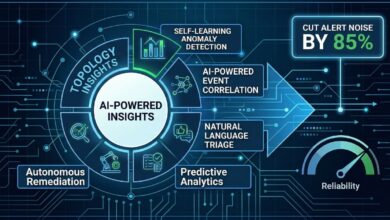
1. Self-Learning Anomaly Detection That Leaves Static Thresholds Behind
Static thresholds, CPU above 90%, memory below 10%, were devised for a simpler time. But in environments with hundreds of microservices running across multiple cloud providers, those fixed lines just generate a lot of noise. Gartner IT teams waste up to 30% of their time on alerts that don’t go anywhere.
Agentic AI-driven anomaly detection forgoes those rigid thresholds for a system that continuously gets to know your environment, learning what normal behavior looks like and flagging deviations that static rules would miss entirely. Do you spot a slow memory leak building up over days? An unusual shift in API response time at 3 am? subtle change in transaction ratios indicates that an upstream service is starting to go down.
Scout’s AI-Powered Insights engine gets to know your environment from day one, adjusting detection sensitivity automatically without needing manual threshold configuration.
2. Context-Aware Root Cause Analysis That Hunts Across the Entire Stack
Correlation tells you which alerts are connected. But AI root cause analysis tells you exactly which component is dead and why. Agentic systems follow dependency chains across infrastructure, application and network layers simultaneously, which is something human operators just can’t do at the speed and scale modern environments demand.
This is where Scout’s foundation in Promise Theory really starts to stand out. Rather than relying on statistical correlations that just guess at causation, our platform models the explicit obligations between every component in your stack. When a service fails to keep its promise, a database response time exceeds its SLA, a load balancer drops connections, the system zooms in on the origin of the broken promise in seconds, not hours.
See how Promise Theory lets you pinpoint root causes with guaranteed accuracy that purely statistical approaches can’t match.
3. Predictive Incident Prevention That Saves You From Those Dreaded Outages
The most expensive incident is the one that your customers spot before you do. Predictive incident prevention is the most valuable thing agentic AI brings to event intelligence: shifting your whole operational posture from reactive firefighting to proactive prevention.
Agentic systems are always on the lookout for historical incident patterns, capacity utilisation trends and real-time performance signals to flag risks before they get out of hand. Your disk is filling at 2% per day? The agent spots it three weeks out and auto-creates a capacity request. A deployment causes a latency regression? The agent detects the statistical shift within minutes and recommends a rollback or does one if you’ve set up for auto-remediation.
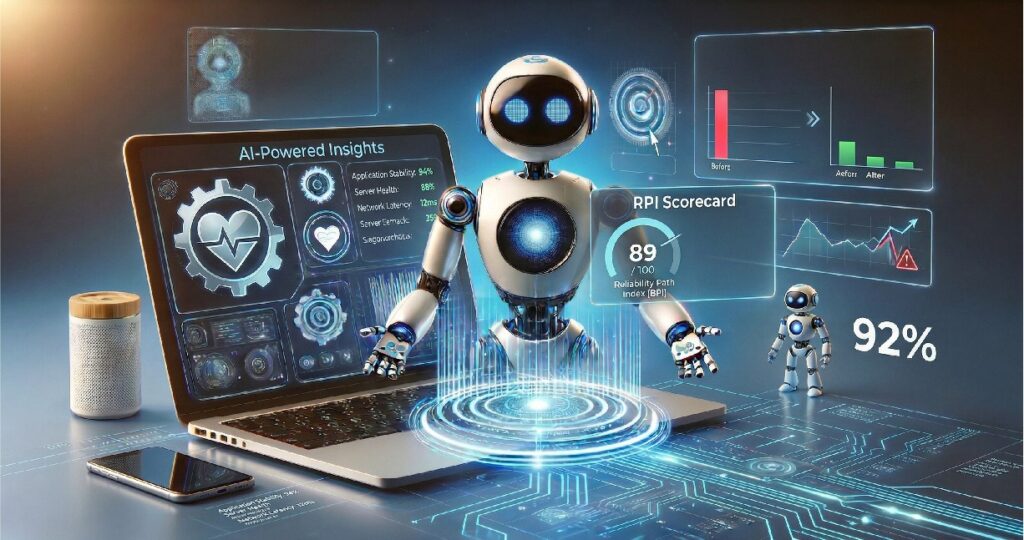
Scout customers claim they can prevent up to 92% of potential outages with this proactive approach, catching issues at the anomaly stage before they become incidents.
4. Governed Autonomous Remediation That Closes The Loop
Detection without action is just an expensive way to watch things burn. The transformative leap agentic AI brings is autonomous incident remediation, the ability to execute fixes, not just recommend them.
In practice, this means having agents that can just restart a service that’s failing, scale up the infrastructure to handle a sudden rush of traffic, roll back a deployment that’s gone wrong, isolate a server that’s been compromised, and kick off special workflows through the IT service management system all without having to wait for a human to get involved. And get this, every action is carefully governed: it’s got to fit within predetermined rules, it’s got to be logged with a complete record of what happened, and it can be easily undone with a single click.
This is the difference between automation, where you’ve got scripts that run automatically when something happens and autonomy, where an agent figures out what needs to be done, when it needs to be done, and why. Scout’s controlled AI workforce operates at a level of disciplined independence that’s exactly like this.
5. Continuous Reliability Scoring: a way to get Engineering and Business on the same page
Agentic AI doesn’t just fix problems it revolutionizes the way organizations go about measuring and talking about reliability. Most teams are juggling a dozen different dashboards, each one showing just a tiny piece of the picture. Executives ask, “How reliable are we?” and get a different answer from every team.
Scout’s Reliability Path Index (RPI) solves this problem by boiling down infrastructure health into a single, real-time score, that takes in things like how long it takes for data to get where it’s going, how well applications are performing, how the servers are doing, the stability of the operating system, the integrity of the logs, and how user experience is being impacted all of which is being constantly updated by the agentic analysis. For the engineers, it’s a journey map to guide them. For the executives, it’s a boardroom-ready metric that ties infrastructure investment to actual business outcomes.
The Operational Impact: Before and After Agentic AI
The numbers tell the story more clearly than any framework deck:
| Metric | Before Agentic AI | With Scout |
| Issue Detection | 2–4 hours after the user reports | 3–5 minutes before impact |
| Root Cause Analysis | 3–6 hours manual investigation | Under 10 minutes with AI |
| Alert Volume (daily) | 200+ alerts, 85% noise | 15–20 actionable incidents |
| Mean Time to Resolution | 4–6 hours average | 45–90 minutes average |
| Outage Prevention Rate | Reactive 0% prevented | Up to 92% prevented proactively |
| Monitoring Tools Required | 5–8 disconnected platforms | Single unified platform |
For teams managing multi-tenant environments, our MSP solution delivers these gains across hundreds of client infrastructures simultaneously.
Why 2026 Is the Inflection Point
Three things are coming together to make agentic event intelligence a must-have rather than a nice-to-have. First, infrastructure complexity is getting out of control we’ve got hybrid cloud, Kubernetes, microservices and edge computing all multiplying the number of things that can go wrong. Second, there just aren’t enough good people to hire to sort through all the alerts. And third, the agentic AI tooling has finally matured – orchestration frameworks, governance models, and autonomous observability platforms are all production-ready now.
IDC’s FutureScape: Worldwide Services 2026 research is calling this the “agentic pivot” – the moment when AI goes from being something you try out and see if it works to being a key part of how you run your business. Companies that make the move now will be able to bring their Mean Time To Resolve (MTTR) way down, cut their operational costs, and free up their engineers to work on innovation rather than just dealing with incidents.
Whether you’re a startup scaling fast or an enterprise managing global infrastructure, there’s a solution that’s right for you: solutions for DevOps Teams, SRE Teams, or Enterprises.
Moving from Reactive Monitoring to Autonomous Operations
You don’t have to rip out your existing stack to make the move to agentic event intelligence. Scout integrates with 300+ monitoring and observability tools – Prometheus, Grafana, Datadog, New Relic, ServiceNow, and many others. Setup is a matter of a few minutes. The platform starts learning your environment right away, and most teams see a real difference in alert noise within the first week.
The platform is SOC 2 Type II certified, HIPAA-compliant and built from the ground up to deal with the kinds of compliance needs that come up in healthcare, financial services and enterprise environments. Your data stays secure, every AI action is auditable, and your team gets back the time they’re currently wasting on noise.
Conclusion
Event intelligence was always about cutting through the noise. Agentic AI takes that promise to further systems that don’t just tell you what’s gone wrong, but figure out why, predict what’s next, and sort it out before anyone’s sleep gets interrupted. Less firefighting, less guesswork, more time spent on engineering that actually moves the needle.
Scout was built for exactly this moment. Book a demo to see it in action, jump into a or grab your free RPI score to find out where you stand right now.
Frequently Asked Questions
Agentic AI gives event intelligence systems the ability to act on their own – not just find all the clues and suggest what to do, but use self-learning baselines to spot anomalies, track down root causes through the whole system, predict incidents before they escalate, and execute governed remediation workflows without waiting for someone to come along and tell them to do it.
Traditional AIOps tools just stop at insight – they correlate events, reduce noise, and give you a good guess at what the problem is. Agentic AI goes the whole way by autonomously working out what to do about problems, figuring out the steps to take to fix things, and then actually taking those steps while keeping within the rules. It takes IT operations from being a human-driven, slow-motion response to an AI-driven, fast-motion resolution.
Governed autonomy means that the AI agents can operate on their own while still staying within the rules and guidelines that you set. Every autonomous action – a service restart, a rollback, a scaling decision – is bound by rules, logged with a full record of what happened, and reversible. You’re always the boss, even if the AI is doing the work.
Promise Theory comes in really handy when it comes to modelling the explicit obligations between every component in your infrastructure. When a component starts to mess up – for example fails to get back to you within the agreed SLA – the system simply traces the broken chain back to the source, and eliminates all the guesswork that usually comes with purely statistical correlation.
RPI is Scout’s one single, unified reliability score that takes into account all the different bits that affect infrastructure health – transit latency, application performance, server health, OS stability, log integrity & user experience – all of which get updated in real time, so both the engineers and the execs have a single metric to work off.
Typically Spear-itAI customers see a 85% reduction in alert noise – the platform uses AI to work out when there’s just too much noise in the system, and collapses all those duplicate, low priority & irrelevant alerts into just a handful of real ones that actually need attention.
Yes, agentic systems can – they work a bit like having a crystal ball, but instead of saying what is going to happen they use historical patterns, capacity trends & real time signals to work out whats coming up, and then prevent it from turning into a full on outage. Our customers say they prevent up to 92% of all potential outages by spotting them early and using automation to sort it out.
No – Scout is designed to work with what you’ve already got in place – it integrates with 300+ different monitoring & observability platforms including Prometheus, Grafana, Datadog & ServiceNow – it’s not meant to replace your individual tools, but rather add an intelligent layer on top of what’s already working for you.
Yes it does – Scout is SOC 2 Type II certified & HIPAA compliant – it has enterprise grade encryption for any data in transit or at rest – and it has been built from the ground up with regulated industries like healthcare, financial services & Government in mind.
Getting set up takes about 5 minutes, and then the platform starts to figure out your environment straight away – most teams see some positive results within the first week – noise reduced, incidents sorted out faster

Tony Davis
Director of Agentic Solutions & Compliance