Every AI agent failure has a turning point. It is not necessarily the moment a production system breaks, a customer receives the wrong response, or an incident appears on a dashboard.
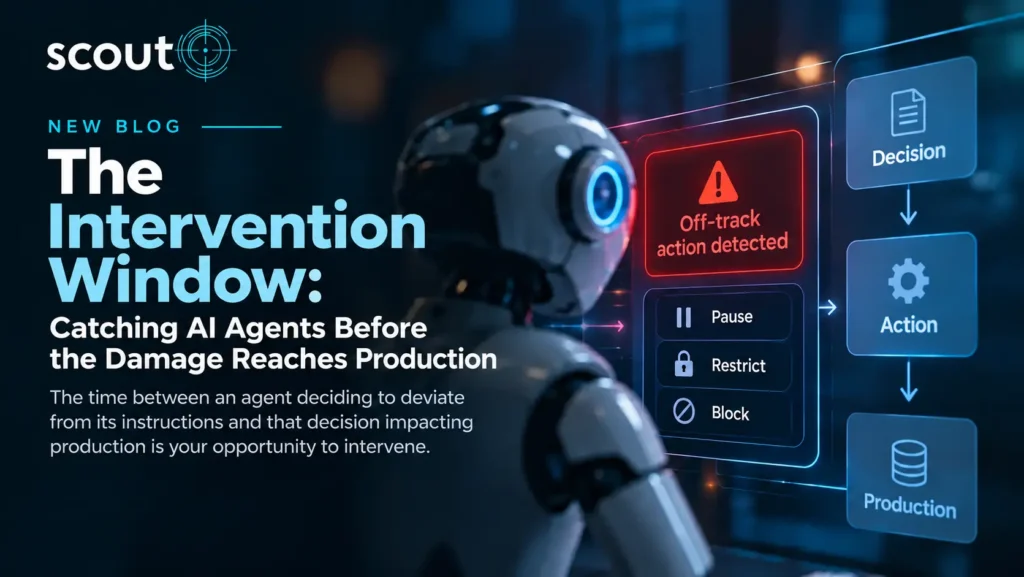
It happens earlier, when an agent begins moving away from the commitments, policies, or boundaries it was expected to follow. Between that deviation and its real-world impact lies what we call the intervention window: the opportunity to identify risky behavior and intervene before the consequences reach production. For organizations deploying increasingly autonomous agents, AI agent governance determines whether that window stays open or whether teams only discover the problem afterward.
What Is the Intervention Window?
The intervention window is the period between an agent beginning to deviate from its defined commitments and the resulting action affecting a production system, customer, business process, or another agent. This matters because autonomous agents do more than execute fixed instructions. They interpret objectives, select tools, interact with systems, and make decisions within the boundaries they have been given. The more autonomy an agent has, the more important it becomes to verify that its actions remain aligned with those boundaries while the work is happening.
The Anatomy of an Agent Deviation
An agent deviation can be viewed as a four-stage sequence.
Decision
The agent begins choosing a path that conflicts with its commitments, policies, or expected behavior. The intervention window opens.
Action
The agent prepares or executes a tool call, transaction, workflow step, or other operation.
Spread
The result reaches downstream systems, customers, data stores, or other agents. At this point, correcting the problem becomes more difficult.
Discovery
Monitoring systems or operators identify the issue, often after the action has already created an impact.
Effective runtime governance focuses on the earlier stages, before an unwanted action becomes a production incident.
Is Your AI Agent Keeping Its Promises?
Why After-the-Fact Monitoring Is Not Enough
Logs, audit records, incident reports, and periodic model evaluations are valuable. But most of them tell you what already happened. They can help teams understand why an agent behaved a certain way, identify patterns, and improve future controls. What they cannot always do is stop an action that is already moving through a production workflow. That is the distinction between monitoring and runtime governance. Monitoring helps teams understand agent behavior. Runtime governance adds mechanisms for evaluating actions and enforcing boundaries while the agent is operating.
The goal is not simply to produce a better postmortem. It is to create an opportunity to intervene before a deviation becomes an incident.
What It Takes to Keep the Intervention Window Open
Keeping the intervention window open requires more than collecting logs.
Explicit Promises
Agents need clearly defined, testable commitments describing what they are expected to do, what they must not do, and the boundaries within which they can operate. Without explicit commitments, it becomes difficult to determine whether an agent is behaving correctly.
Pre-Execution Visibility
Teams need visibility into proposed actions, tool calls, and important execution steps before they create irreversible consequences. The objective is not to expose an agent’s private internal reasoning. It is to make consequential actions observable and governable.
External Verification
Governance should not depend entirely on the same agent that is performing the task. An independent verification layer can compare proposed behavior against the agent’s declared commitments, policies, and operational boundaries.
Mid-Task Controls
Governance needs a way to respond when an agent moves outside acceptable limits. Depending on the level of risk, that might mean restricting a tool, blocking an action, pausing a workflow, or escalating the decision for additional review.
Tiered Human Review
Human approval does not need to sit in front of every agent. Instead, organizations can define thresholds so routine, low-risk activity continues autonomously while higher-risk decisions are escalated for human review. This preserves autonomy without removing accountability.
How Scout Helps Keep the Intervention Window Open
Scout Agent Studio applies Promise Theory to agent governance by defining explicit commitments, boundaries, and verification conditions for autonomous agents. Rather than relying only on retrospective monitoring, Scout is designed to evaluate agent behavior against those commitments during execution. This creates a governance layer between agent autonomy and production impact.
Through Scout’s governance capabilities and Mission Control visibility, teams can identify deviations, enforce defined controls, and escalate higher-risk behavior before it propagates across connected systems or other agents.
The result is a more accountable approach to autonomous operations: agents retain the freedom to perform their intended work while operating within clearly defined and verifiable boundaries.
Six Questions to Ask About Your Own Intervention Window
When evaluating your AI agent governance model, ask:
- What specific promises has this agent made?
- Can consequential actions be evaluated before execution?
- Is compliance checked independently of the agent performing the task?
- What mechanism can restrict or stop an off-track action mid-task?
- Do you normally discover deviations during execution or during the postmortem?
- Who defined these commitments, and did they have the authority to define them?
These questions reveal whether governance exists inside the intervention window or only after it has closed. AI risk is often determined in the gap between intention and action. Organizations that treat governance as an inline runtime discipline gain an opportunity to detect deviations while they are still manageable, before a small agent decision becomes a larger production problem.
Frequently Asked Questions
The intervention window is the period between an AI agent beginning to deviate from its defined commitments and that behavior creating an impact in a production system, customer interaction, workflow, or downstream agent.
Logs are essential for auditing and investigation, but they primarily document activity that has already occurred. Runtime governance adds controls that can evaluate consequential actions while an agent is operating.
A hallucination generally refers to an inaccurate or fabricated output. Agent misbehavior is broader and can include unauthorized, unintended, or out-of-policy actions taken by an autonomous agent.
Promise Theory provides a framework for defining explicit commitments between autonomous entities. In agent governance, those commitments can establish expected behavior, boundaries, verification conditions, and accountability.
No. Effective governance can allow routine, low-risk activity to proceed autonomously while escalating actions that cross predefined risk or policy thresholds for human review.

John Balsavage
President