Introduction
It’s 2 AM, and your on-call engineer’s phone has been blowing up nonstop for the past hour. 12 of those alerts were essentially nothing: a CPU spike from the nightly backup, a tiny network glitch that fixed itself, and three monitoring tools all screaming about the same non-issue that wasn’t really an issue at all.
And then there was that one real alert: a database connection pool was dying and on the verge of taking down the customer-facing side of your business. But your engineer was so sick of being woken up for nothing that they’d stopped paying attention even to the real ones.
This isn’t some hypothetical. According to NeuBird AI, 44% of companies experienced outages in the past year directly linked to suppressed or ignored alerts. Alert fatigue has moved from being a minor nuisance to a serious production reliability risk, and it needs a real solution, not just a new dashboard to look at.
That solution is an event intelligence system specifically designed to eliminate alert fatigue at its root.
A practical checklist to assess alert noise, incident routing, escalation quality, and response efficiency
Why Tuning Thresholds Will Never Fix Alert Fatigue
Most teams try to beat alert fatigue by tweaking thresholds, muting loud monitors, or adding severity tags. These are temporary band-aids that just cover up the symptoms without actually fixing the underlying problem.
Alert fatigue is driven by three main forces working together:
Fragmented tooling creates duplicate noise. When your APM tool, your infrastructure monitor, and your cloud native alerts are all firing off independently for the same issue, your team gets five notifications instead of just one. The NeuBird AI report found that 83% of teams use four or more tools during a live incident.
Static thresholds ignore context. A CPU spike at midnight during a scheduled batch job is no big deal. But the same spike at noon during a busy time is a major red flag. Traditional monitoring treats both the same way.
Alerts lack dependency awareness. When a single piece of storage starts to die, it triggers alerts on every service that depends on it. Your team sees thirty alerts. The real problem is just one.
An event intelligence system tackles all three of these problems at once.
How Event Intelligence Breaks the Alert Fatigue Cycle
The shift from noise to signal happens in five stages, each one building on the last to deliver more and more value.
1. Cross-Domain Correlation That Squeezes Out the Noise
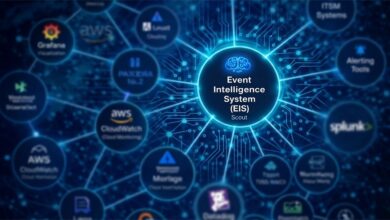
The AI correlation engine takes in events from every source in your environment and groups them all based on what’s dependent on what, how things are mapped out, and what patterns are happening over time. Those thirty alerts from a storage failure get clumped down into a single incident with a clear root cause.
Scout manages to get an 85% reduction in alert noise using this correlation layer. A team that was getting 800 alerts a day is now down to about 120 meaningful incidents, each one with a bunch of extra context and information, not just stripped back.
2. Business Impact Scoring That Tells You What Matters
Not every incident needs to wake someone up at 2 AM. An event intelligence system maps out the technical failures to business services and gives you a real-time score of how much impact they have, which customers are affected, what revenue streams are at risk, and which SLAs are getting close to a breach.
A P1 label on a ticket might tell you that someone thought it was urgent, but a business impact score tells you exactly why it’s urgent and how much is at stake. Your team stops guessing and starts acting on real data.
3. Predictive Detection That Catches Failures Before They Happen
The most powerful way to get rid of alert fatigue is to prevent the incident that would have generated all those alerts in the first place.
Machine learning models inside the event intelligence platform go through historical data and current anomaly trends to detect potential incidents 15-30 minutes before they happen. A slow memory leak that would have triggered fifty alerts during a crash is caught before it even starts and resolved quietly without needing to wake anyone up.
This is the difference between proactive IT monitoring and reactive firefighting.
4. Automated Root Cause Analysis That Kills Investigation Time
Vectra’s State of Threat Detection research found that SOC teams deal with an average of 4,484 alerts a day, and 67% of those get ignored. It’s not because people are lazy; it’s because manual investigation just takes too long to give each alert the attention it needs.
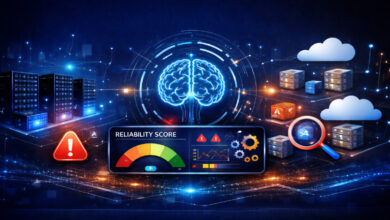
An event intelligence system automates root cause analysis by linking events with recent changes, deployment histories, and infrastructure topology. Scout’s Reliability Path Index takes all that info and turns it into a single reliability score across the whole of your stack so you can see how healthy your infrastructure is at a glance, not after an hour of digging.
5. Intelligent Routing That Gets Rid of Manual Triage
Alert fatigue gets worse when engineers get incidents they have no idea how to deal with wrong domain, wrong expertise, wrong escalation path. Event intelligence tackles triage by automatically routing alerts enriched with business context and a clear picture of who’s responsible. The DevOps team gets the lowdown on application incidents tied to deployments. The infrastructure team gets notified of hardware events with a handy topology map. And the SRE team gets reliability risk signals that take into account their SLO budgets. No one’s wasting time on stuff that doesn’t belong to them, and no one’s getting bogged down in pointless noise.
What Changes When Alert Fatigue Disappears
Let’s be blunt, the impact of wiping out alert fatigue isn’t incremental; it’s a game-changer. Suddenly, MTTR plummets. Engineers aren’t stuck dealing with a mountain of disconnected alerts. Instead, they get a handful of correlated incidents that make sense and can get to the bottom of the problem in minutes, not hours. Manual investigation is a thing of the past, and response times shrink dramatically.
On-call stops being a nightmare. Engineers trust the alerting system to send them the right info at the right time. As a result, they respond faster and with more confidence. A report from NeuBird AI in 2026 showed that over 60% of engineering teams spend 40% or more of their time on incident management, which just melts away when alert fatigue lifts.
Proactive ops become the norm. Predictive intelligence starts catching potential problems before they even become an issue, long before downtime kicks in. No more explaining outages to customers, no more downtime to deal with. Prevention gets to be the default mode.
Costs come down where they really matter. Gartner reckons downtime costs businesses $5,600 per minute. Even a bit of improvement in alert quality and response speed adds up to real financial savings especially for big enterprises and managed service providers who have a lot to lose.
Why Scout is Built to Solve This Problem
Scout wasn’t built as a monitoring tool with AI bolted on afterwards. It was designed from the ground up as a fully autonomous IT operations platform based on event intelligence. Its foundation on promise theory means that every AI decision is safe, predictable, and easy to understand. The governed AI workforce, made up of agents for correlation, prediction, drift detection, and summarization, actively works with your infrastructure, not just looks at it. And with a 5-minute setup, you’re not waiting months for results.
Tha Event Intelligence Platform processes millions of events per second, supports hybrid and multi-cloud environments, and carries SOC 2 Type 2 and HIPAA compliance certifications.
Conclusion
Alert fatigue isn’t the cost of running modern infrastructure; it’s the cost of running it without any brains. Every ignored alert, every false positive that breaks up your concentration, every missed incident that turns into a customer-facing outage are all symptoms of a system that never had a thought.
An event intelligence system changes the odds entirely. Fewer alerts means a clearer signal, faster resolution, and happier engineers.
Ready to eliminate alert fatigue? Book a Demo with Scout today.
Frequently Asked Questions
It eliminates alert fatigue by correlating thousands of raw alerts into a small number of meaningful incidents using AI-powered dependency mapping, topology intelligence, and business impact scoring, so your team only sees what actually requires action.
Alert noise reduction typically mutes or suppresses alerts based on rules. Event intelligence goes further, it correlates related events, identifies root causes, predicts failures, and prioritizes incidents by business impact, addressing the structural cause of alert fatigue rather than just its symptoms.
Scout achieves an 85% reduction in alert noise through intelligent event correlation. Depending on the environment and tooling complexity, organizations typically see noise reduction between 85% and 99%.
Yes. Machine learning models analyze historical patterns, current anomaly trends, and infrastructure baselines to detect potential incidents 15–30 minutes before they occur, enabling proactive prevention instead of reactive firefighting.
It reduces MTTR by automating root cause analysis, correlating related events into single incidents, attaching probable root causes with deployment and change context, and routing incidents to the right team automatically, eliminating hours of manual investigation.
No. Teams of all sizes benefit from eliminating alert fatigue. Scout offers solutions for startups, DevOps teams, SRE teams, managed service providers, and enterprises with a 5-minute setup that requires no complex onboarding.
The Reliability Path Index (RPI) is a unified reliability score that translates event intelligence data into a single metric representing your entire infrastructure’s health. It replaces the need to manually interpret hundreds of alerts by giving you one clear signal.
yes. Scout integrates with existing monitoring tools, log aggregators, APM platforms, network devices, and cloud services, ingesting events from all sources and normalizing them for unified correlation and analysis.
Promise Theory ensures that AI agents behave autonomously, predictably, and explainably. ScoutI is the only event intelligence platform built on Promise Theory, which means its decisions are transparent and governable, not a black box.
Scout is designed for rapid deployment with a 5-minute setup. It includes enterprise-grade security, HIPAA compliance, and SOC 2 Type 2 certification ready for production environments from day one.

Tony Davis
Director of Agentic Solutions & Compliance