Introduction
Enterprise AI is quietly shifting from solo assistants to swarms. Instead of one model doing everything, you get a coordinated team of specialized agents: one forecasts risk, another correlates signals, and another runs remediation, cooperating to keep systems running. The scale is appealing. The governance problem is brutal.
A swarm works because no single agent is in charge. That’s also why most enterprises hit a wall when they try to put one in production. Emergent behaviour is hard to audit, drift compounds quietly across agents, and there’s no clean way to ask “why did the swarm just do that?” Promise Theory is the missing layer. Combine it with a swarm architecture and you get distributed AI that is genuinely decentralized and verifiable at the same time.
This article looks at why swarm intelligence alone isn’t enough for enterprise use, what Promise Theory adds when you put it on top, and how Scout’s Agentic Workforce Framework already runs as a Promise-governed swarm in production.
Why Pure Swarm Intelligence Falls Short for Enterprise AI
Swarms are good at exactly what hierarchical systems are bad at: scaling, adapting, and surviving the loss of individual agents. They’re also bad at exactly what hierarchies are good at: explaining themselves.
The failure modes are familiar to anyone who has tried to operate a multi-agent system in anger:
- Collective opacity. You can audit any single agent’s logic, but not the behaviour that emerges when twenty of them interact. The output is real; the reasoning is distributed across agents and inputs that don’t exist in one place.
- Hallucination cascades. One agent’s confident-but-wrong output becomes another agent’s input. Errors compound across the swarm before anyone notices, because each handoff looked plausible.
- Drift without a tripwire. Agents update their internal state on the fly. Over weeks, the swarm’s collective behaviour shifts away from its original intent, and there’s no central control loop to detect it.
- Resilience without accountability. A swarm keeps running when an agent fails, which is great. But “we don’t know which agent decided that” is not an acceptable answer to a CIO, an auditor, or an SRE on a 2 a.m. call.
Pure swarm intelligence gives you scale and resilience. It does not give you the traceable, explainable, governable behaviour enterprise AI actually requires.
What Promise Theory Brings to Swarm Architectures
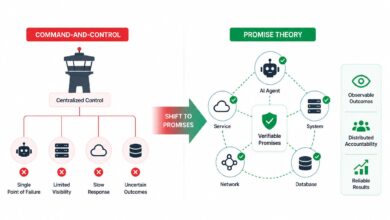
Promise Theory does something deceptively simple: it makes each agent in the swarm declare what it will do, in terms specific enough to be checked later. Cooperation stays voluntary; no agent commands another, but every action now has a commitment attached to it.
That changes three things in a swarm:
- Per-agent accountability without sacrificing autonomy. Each agent owns its promises and can be held to them individually, even though no one is telling it what to do. The swarm stays decentralized; accountability stops being collective.
- Observable interactions. Promises become how agents advertise their behaviour to each other. When agents coordinate through declared commitments instead of opaque outputs, the swarm becomes legible; you can see which promises are flowing, which are being kept, and which are starting to slip.
- Audit at any scale. A promise is a natural unit for governance. Whether you have ten agents or ten thousand, the question is the same: did this agent keep its commitment? That’s the kind of structure frameworks like ISO 42001 expect, and it’s nearly impossible to retrofit onto a pure swarm.
Promise Theory doesn’t slow the swarm down. It just gives you a way to know what it’s doing.
How the Combination Works in Practice
The synthesis is architectural rather than philosophical. You put a verification layer over a coordination model, keeping what swarms are good at, fixing what they aren’t.
Each agent publishes its own promises
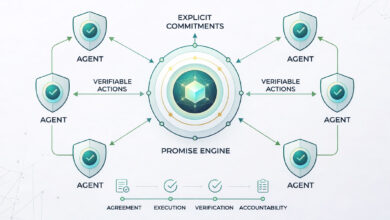
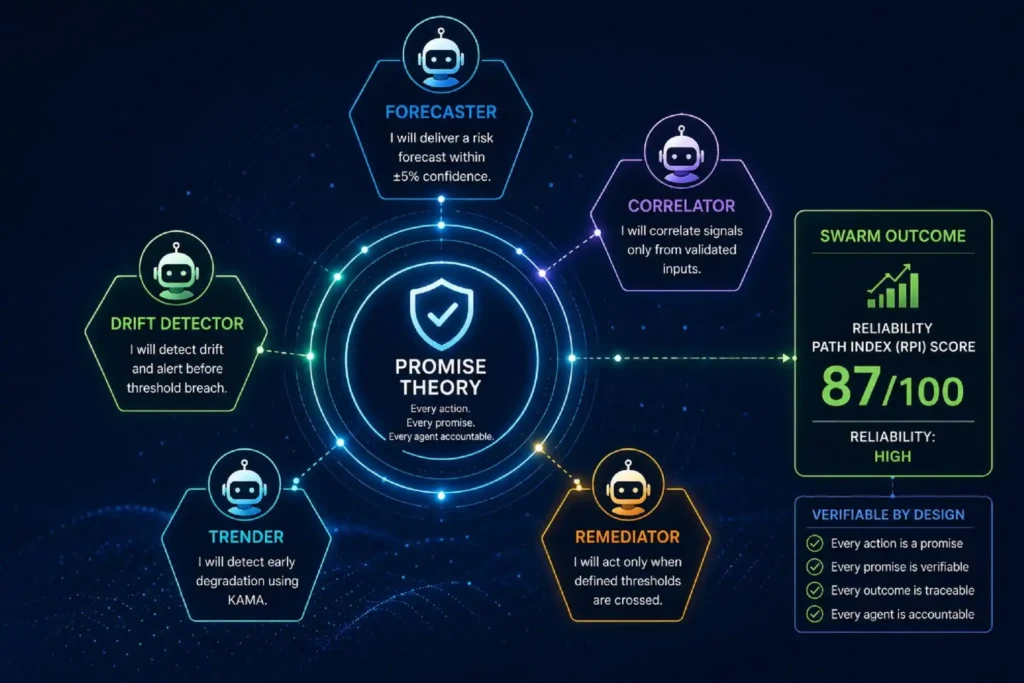
Every agent in the swarm — forecasting, correlation, remediation, and anomaly detection — declares what it will do and the conditions under which it will do it. A forecasting agent promises a prediction within a confidence band. A remediation agent promises to act only when specific thresholds are crossed. Because the promise comes from the agent that actually controls the behaviour, it’s realistic rather than aspirational.
Coordination through shared signals, not central commands
Swarms coordinate through shared state, not direct orders. The technical term is stigmergy. Promise Theory fits this naturally. Agents read each other’s promises and act accordingly: a correlation agent reads the forecasting agent’s confidence band before deciding how heavily to weight its input. There’s still no central commander. There’s just a more legible environment for agents to cooperate in.
Swarm-level outcomes mapped to individual commitments
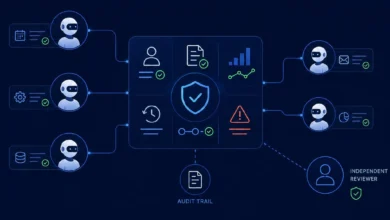
When the swarm produces an outcome — a remediation, an alert, a reliability prediction — you can trace it back to the individual promises that fed it. Drift becomes detectable, because a broken promise is a measurable event. Hallucination cascades become interruptible, because the first slipped commitment is a signal to stop, not just a wobble in confidence. You end up with a system that is decentralized in its coordination and centralized in its accountability — exactly what enterprise AI has been struggling to build.
The Enterprise Blueprint for Promise-Governed AI Swarms
Applications in IT Operations, Observability, and Reliability Engineering
Operationally, this combination is where multi-agent AI stops being a science experiment and starts paying off.
For observability, you stop watching every raw signal and start watching whether the swarm is keeping its promises. That’s real noise reduction at scale, a smaller, more meaningful set of conditions to alert on. For MTTR, a broken promise points straight to the responsible agent, its inputs, and its policy version, so you’re not reconstructing the swarm’s behaviour from scattered logs after the fact. For drift detection, the swarm itself becomes the canary: when its collective promises start slipping against an objective benchmark, you see it before customers do. And for governance, every autonomous decision carries a verifiable lineage, which is what makes AI governance auditable instead of aspirational.
How Scout Operationalizes the Promise-Governed Swarm
Building this architecture from scratch is a multi-quarter engineering effort. Scout’s Agentic Workforce Framework runs as a Promise-governed swarm in production today.
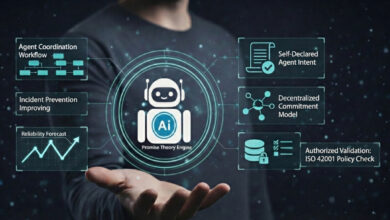
Inside the framework, specialized agents cooperate without a brittle central brain. Predictor runs Monte Carlo forecasting against reliability outcomes. Blender applies Six Sigma analysis to separate systemic issues from noise. Trender uses Kaufman’s Adaptive Moving Average to detect early degradation. Drift detection, correlation, and anomaly agents handle their own domains. Each agent publishes its commitments through Scout’s Promise Theory engine, and an orchestrator coordinates routing and escalation without overriding any agent’s promises.
The swarm’s collective output is anchored to one benchmark: the Reliability Path Index (RPI) Score. RPI condenses thousands of metrics into a single, business-readable reliability number, which means the swarm-level promise is something a CIO and an SRE can both read off the same page. When that score moves, you can trace which agents’ promises moved it and why. The result isn’t a clever demo, it’s a coordinated swarm whose individual commitments and collective outcomes are both observable, in plain language, across hybrid cloud monitoring and on-premises environments.
What Enterprise Leaders Should Do Next
If you’re designing or buying multi-agent AI for production, treat Promise Theory as a requirement, not a feature.
- Require explicit promises from every agent. If an agent in a vendor’s swarm can’t tell you what it’s committing to, you have no governance.
- Make promises the audit unit. Build review processes around whether commitments were kept, not whether code ran.
- Anchor swarm output to a business-readable score. A single index lets technical and executive stakeholders share one source of truth and keeps reliability programs funded.
- Demand traceable lineage. Every swarm-level outcome should map back to specific agent promises, inputs, and policy versions. Without that, you have an opaque collective, not governed AI.
Conclusion
Pure swarm intelligence gives you scale. Promise Theory gives you trust. Combining them gives you autonomous operations that enterprises can actually run.
Explore how Scout applies Promise Theory to govern its Agentic Workforce, see how the RPI Score measures swarm-level reliability, and Request a demo to see a Promise-governed agent swarm running in a real environment.
Frequently Asked Questions
Swarm intelligence is a model where many specialized agents cooperate through local interactions to produce collective behaviour, without a central controller. Applied to AI, it lets systems scale beyond what one model or one orchestrator can handle.
It gives every agent in the swarm a way to declare what it will do, so cooperation stays voluntary but each agent’s behaviour remains verifiable against its commitment.
Swarms scale but are opaque. Promise Theory is verifiable but doesn’t produce collective behaviour. Together they give you decentralized AI that is observable, auditable, and governable at scale.
A multi-agent system can include hierarchical or peer agents working on related tasks. A swarm specifically emphasizes decentralized coordination, local rules, and emergent collective behaviour rather than top-down control.
By expressing each agent’s role as an explicit promise and measuring outcomes against those commitments. Emergence becomes governable because every collective result traces back to individual declared behaviours.
Stigmergy is indirect coordination through shared signals in the environment. Agents act on what other agents have left behind, not on direct orders. Promises fit naturally as those signals: an agent’s commitment is the artifact that other agents read and react to.
By making every autonomous action a checkable promise. The first slipped commitment becomes a tripwire, halting cascades before they propagate across the swarm.
Scout runs specialized agents — forecasting, correlation, drift detection, trend analysis, and remediation — each operating under explicit promises validated by its Promise Theory engine, coordinated by an orchestrator that doesn’t override individual commitments.
The Reliability Path Index condenses thousands of metrics into one business-readable score, giving the swarm’s collective output a single benchmark its individual promises can be measured against.
By treating each promise as an audit unit. Every collective outcome carries a lineage back to specific agent commitments, inputs, and policy versions, which is what makes governance possible at swarm scale.

Tony Davis
Director of Agentic Solutions & Compliance