Introduction
Most enterprises think of an agentic workforce as a deployment list: agents installed, agents running, agents producing outputs. That’s a payroll spreadsheet, not a workforce.
A reliable workforce the human kind doesn’t get its reliability from hiring good people. It gets reliability from the structures around the people: clear roles, written commitments, independent reviews, durable records, and consequences when commitments break. Those structures are how organisations make individual autonomy compatible with collective accountability.
The same principle applies to agentic AI. A workforce of autonomous agents only becomes reliable when those same structures sit around it. Promise Theory provides them not as a feature label, but as a governance discipline. This piece walks through the five workforce practices a reliable agentic AI estate actually needs, and how each one maps to a governance property that Promise Theory makes structural.
Job Descriptions: What Each Agent Commits To
In a human workforce, the job description is the worker’s first declaration: what they’re responsible for, what they’re not, and the conditions under which they’ll act. No serious organisation hires without one.
In an agentic workforce, this is the declared commitment. Each agent publishes what it will do, in terms specific enough to be checked. A scheduling agent commits to producing schedules that meet certain constraints. An approval agent commits to approving only when specific conditions hold. The commitment isn’t aspirational. It’s the contract under which the agent operates.
Most enterprise agentic AI skips this step entirely. Agents get deployed without explicit role definitions, and the team finds out what each agent commits to by watching what it does. That’s like discovering what a new employee thinks their job is by waiting six months and seeing what they neglected. It’s the wrong direction.
Performance Review: Who Actually Watches the Worker?
A human performance review only works when the reviewer is someone other than the person being reviewed. Self-assessment alone is too easy to game. Most organisations don’t realise how seriously they take this rule until they encounter an agentic AI vendor who’s broken it.
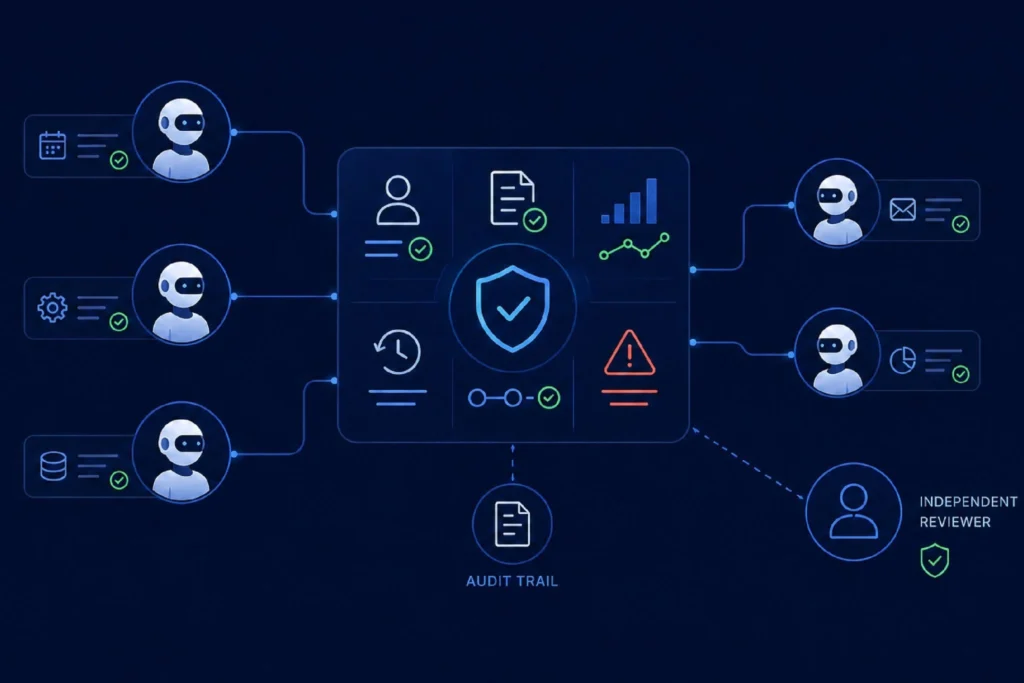
In an agentic workforce, the equivalent is independent verification. Each agent’s behaviour is checked against its declared commitments by an entity outside the agent itself. The verifier doesn’t share the agent’s model, doesn’t share its confidence, and isn’t built into the same loop. That separation is what makes the review honest.
This is the property most “Promise Theory” implementations quietly skip. They label outputs as commitments, then let the same model judge whether the commitments were met. The number says 98% promise compliance because the worker is grading their own homework. A reliable workforce can’t operate that way for long, agentic or human.
The Personnel File: Every Decision on Record
A reliable workforce keeps records. When a worker makes a consequential decision, the organisation can later find out what they decided, what information they had at the time, and which policy was in force. That’s not bureaucracy. It’s the foundation for any later review, accountability conversation, or audit.
The agentic equivalent is decision lineage. Every autonomous action carries a structured record back to the commitment that preceded it, the inputs that informed it, and the policy version in force at the time. Lineage doesn’t get reconstructed after an incident. It gets emitted as a side-effect of normal operation, so it’s already there whenever it’s needed.
When a regulator, board, or internal review asks “show me what this agent did and why,” a workforce with a proper personnel file answers in minutes. A workforce without one starts the archaeology project.
References: Trust That Has to Be Earned
In a human workforce, references are how trust travels. You don’t give a new employee unsupervised authority on day one; you give it gradually as they accumulate a record of honoured commitments. Trust isn’t an opinion someone holds about a worker. It’s a record someone can show.
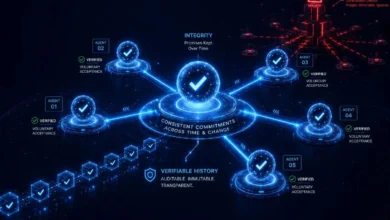
In an agentic workforce, this is the accumulated promise-keeping record. Trust accumulates as evidence over time, per agent and across the workforce. Which agents reliably honour their commitments? Which ones drift? When did a particular agent’s commitment-keeping start to slip? Those questions are only answerable when the record has been kept honestly and continuously.
Most teams skip this and treat trust in agentic AI as a deployment decision: the vendor pitched well, the demo looked clean, the model passed evals, so the agent is trusted. That’s hiring on the strength of the interview, then never reviewing the work. It holds up until it doesn’t, and the failure mode is usually expensive.
Consequence: What Happens When Commitments Break
A reliable workforce has structural consequences for broken commitments. The employee who repeatedly misses deadlines doesn’t get the next high-stakes project. The team member who can’t be relied on gets reassigned. The worker whose behaviour drifts outside their job description gets a conversation, and eventually a different role.
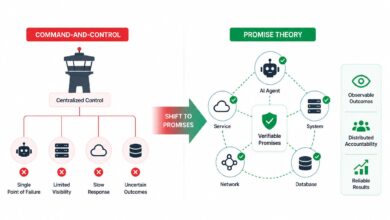
In an agentic workforce, consequence is what separates real commitments from decorative ones. When an agent’s output falls outside its declared commitment, downstream agents stop consuming it. The promise itself acts as a stop signal the cascade halts at the first broken commitment instead of propagating across the workforce. Escalation engages the right people with the right context. The agent in question doesn’t keep receiving consequential work until verification clears.
Without that consequence structure, a “promise” is a piece of vocabulary. With it, the workforce holds itself accountable in something close to real time, the same way a healthy organisation does.
The 5 Pillars of a Reliable Agentic Workforce
How Scout Operates the Workforce This Way
Inside Scout’s Agentic Workforce Framework, agent governance is designed around these workforce-style practices rather than wrapped around an existing architecture afterwards. Each agent owns the commitments it makes its job description, in the language of this piece. Scout’s Promise Theory engine acts as the independent reviewer, validating agent behaviour against declared commitments through verification that doesn’t sit inside the agent. Every autonomous decision carries a structured lineage the personnel file including commitment, inputs, and policy version. The promise-keeping record accumulates as the agent’s references, building or eroding trust over time. And when commitments break, the consequence flows through the workforce as designed.
Scout applies these governance principles. It doesn’t claim to own them. Promise Theory is bigger than any product, and treating an agentic workforce like a real workforce with the discipline that implies is the foundation any reliable agentic AI architecture has to rest on.
What to Demand From Your Agentic Workforce
A short test. If a vendor or internal team claims you have a reliable agentic workforce, ask:
- Show me the job description for any agent in production. (Declared commitment.)
- Show me who reviews whether the agent did what its job description said. (Independent verification.)
- Show me what that agent did on a specific date, with the policy in force at the time. (Decision lineage.)
- Show me how that agent’s commitment-keeping record has changed over the last quarter. (References.)
- Show me what happened the last time an agent broke a commitment. (Consequence.)
Conclusion
A reliable agentic workforce isn’t built by choosing better agents. It’s built by giving the workforce the same governance discipline a well-run company gives its people: written commitments, independent review, durable records, earned trust, and real consequences when commitments break. Promise Theory is how those structures get built into the architecture rather than bolted on after the fact.
Explore how Scout implements Promise Theory inside the Agentic Workforce Framework, run the five question test above against your current agentic AI estate, or request a demo to see a Promise governed workforce in operation.
Frequently Asked Questions
It means giving each agent a defined role, checking whether the agent stays within that role, keeping a record of what the agent does, and creating consequences when the agent’s behaviour drifts the same structural moves a competent organisation makes around its human workers.
Because reliability doesn’t come from individual capability. It comes from the structures that surround the worker commitments, review, records, consequence. A workforce of capable models without those structures behaves like a workforce of capable people with no manager, no role definitions, and no review cycle: occasionally brilliant, frequently surprising, and impossible to govern.
A declared commitment specifying what the agent will do, the conditions under which it will do it, and what counts as staying inside the role written in something the verification system can check, not just human-readable text.
A verification system outside the agent, independent of the model that committed. Self-review by the agent isn’t a review. The verifier has to sit in a position where it can disagree with the agent.
A structured record of every consequential decision: the commitment the agent was operating under, the inputs it had access to, the policy version in force, the action it took, and whether the action matched the commitment. Lineage that survives any later question.
By accumulating a record of honoured commitments. Trust in a Promise Theory–governed workforce isn’t given at deployment; it’s earned cycle by cycle. When an agent’s commitment-keeping record is strong over time, the workforce can give it more consequential work. When the record weakens, the opposite.
Not necessarily removing the agent sometimes restricting its authority, reassigning its work, or holding it in a constrained role until verification can re-establish confidence. The point is that broken commitments have structural consequences, not just logged events.
By designing each agent to own its commitments, routing verification through an independent Promise Theory engine, recording lineage on every autonomous decision, accumulating commitment-keeping records over time, and wiring broken commitments into the workforce’s consequence structure rather than letting them flow downstream.
Partially. Commitment declaration and independent verification can be layered on top of most platforms. The deeper structures consequences wired into the workforce, accumulated trust records, lineage as a built-in property work best when the agents are designed under the model from the start.
Treating an agentic workforce like a deployment problem rather than a workforce problem. Once you accept that what you’re building is a workforce of autonomous workers cooperating to do real operational work, the governance disciplines you’d apply to any other workforce become non-negotiable.

Tony Davis
Director of Agentic Solutions & Compliance