Introduction
In the last eighteen months, Promise Theory has gone from a niche cooperation model used in distributed systems to a marketing line on nearly every agentic AI vendor’s website. That’s a problem.
The concept itself is sound: autonomous agents need declared, verifiable commitments to be trustworthy at scale. But when a term gets adopted faster than its operational discipline, what you end up with is a lot of products that say “Promise Theory” and very few that actually do it. The label gets cheap. The reader can’t tell which agentic system is genuinely accountable and which one just renamed its existing outputs as “promises.”
This piece is a buyer’s skepticism guide: five patterns to watch for, what each one looks like in the wild, and what real Promise Theory in an agentic system actually requires.
Why Promise Theory Adoption Outpaced Operational Rigor
Promise Theory works because it makes accountability explicit: every agent declares what it will do, and every action gets checked against that commitment. The work is in the checking: verification, lineage, independent judgment, and adaptation over time. None of that work is visible on a feature comparison page.
What’s visible is the word “promise.” So that’s what spread. Agent vendors built dashboards that label outputs as “agent promises,” ship a one-page governance brief, and check the box. The rigor, the part that makes promises something other than aspirational text, gets quietly skipped.
The dynamic is reinforced by how the buying side works. Procurement cycles reward features that can be demoed in twenty minutes; operational rigor takes months to evaluate and rarely survives the slide deck. Compliance teams want to see the word “Promise Theory” next to ISO 42001 on a checklist. The label gets the deal closed; whether the implementation holds up under inspection is somebody else’s problem six months later.
The deception patterns below are what skipped rigor actually looks like when you go to inspect it.
Five Ways Promise Theory Gets Faked in Agentic Systems
Promises without verification
The most common failure: an agent publishes a commitment, takes action, and no one, no system, no second agent, no out-of-band check, ever measures whether the commitment held. The “promise” is a published string. It influences nothing.
A real implementation has a dedicated verification path for every commitment type. If a vendor can’t show you what happens between “agent promised X” and “agent did Y,” they don’t have Promise Theory. They have logging with better marketing.
Self-attested verification
The next layer up is more subtle. Verification exists, but the agent who committed is also the one judging whether it kept it. That’s a self-graded exam, not Promise Theory. Any model confident enough to act is confident enough to declare its own action a success.
Real Promise Theory requires independence between the agent making the promise and the agent (or system) verifying it. If the same model decides what to commit to and whether it delivered, you’re inside a closed loop with no external truth.
Aspirational commitments dressed as operational ones
This is the pattern that fools the most technical buyers. The “promises” are well-written, well-structured, and meaningful as descriptions of intended behaviour. They are not, however, things the system actually checks. They describe what the agent should do in principle, not what it has to do in practice.
A working test: ask what happens when the commitment is broken. If the answer is “we log it” or “an operator reviews it later,” the promise is aspirational. If the answer is “downstream agents stop consuming the output, and a remediation path engages,” the promise is operational.
Promise drift
Promise drift is the audit-breaking pattern: the commitments themselves get quietly adjusted to match what the system is actually doing, instead of the system being held to its original commitments. The numbers always look great because they’ve been redefined.
This is hard to spot from the outside because the dashboard reads “98% promise compliance” either way. The diagnostic is the version history. Real Promise Theory implementations keep an immutable record of what was promised when, separate from what was delivered. If commitments are mutable and undated, the audit trail is fiction.
Bolt-on Promise Theory
The last pattern is architectural. Vendors with existing agent platforms add a “Promise Theory layer” on top: a parser, a labelling system, a compliance overlay. The agents underneath weren’t designed with commitments in mind. They were retrofitted with promise-shaped wrappers.
The tell is integration depth. Real Promise Theory shapes how agents are specified, how they coordinate, how they escalate, and how they’re observed. Bolt-on Promise Theory shapes the marketing collateral. If pulling the “Promise Theory” feature out of a platform would leave the underlying behaviour unchanged, it was decorative.
What Real Promise Theory in Agentic Systems Requires
The patterns above all fail the same underlying tests. Operational Promise Theory has five non-negotiable properties:
- Independent verification. The entity judging whether a commitment was kept is not the entity that made it.
- Evidence on demand. Any autonomous outcome can be traced back to the commitment, the inputs, and the policy version that produced it.
- Immutable commitment history. What was promised, and when, is a separate, append-only record from what was delivered.
- Consequence when promises break. A broken promise changes downstream behaviour; it doesn’t just produce a log line.
- Architectural integration. Commitments shape how agents are designed and coordinated, not how their outputs are labelled.
If a system has all five, it has Promise Theory. If it’s missing any of them, what it has is closer to monitoring with extra steps.
Operational Promise Theory Buyer’s Guide
How Scout Treats Promise Theory as Architecture, Not Marketing
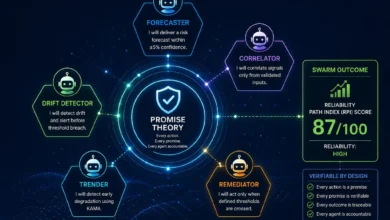
Inside Scout’s Agentic Workforce Framework, commitments are part of how agents are designed, not labels applied to their outputs. Each agent owns the commitments it makes. Orchestrators handle routing and escalation, but they don’t override the commitments individual agents have already declared. The relationship between orchestrator and sub-agent is voluntary cooperation, not imposed control.
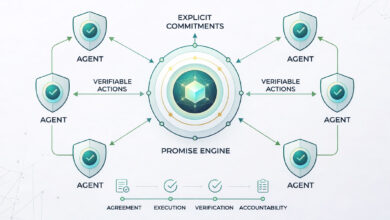
Scout’s Promise Theory engine validates those commitments before and after action, independently of the agent that made them. The agent committing is not the agent judging whether it kept it. Every autonomous decision carries a structured lineage from outcome back to its commitment, inputs, and policy version, with evidence available on demand rather than reconstructed after an incident.
Accountability boundaries between agents are explicit on purpose, and the record of promise-keeping accumulates as evidence rather than assertion. Scout applies these governance principles. It doesn’t claim to own them. Promise Theory is bigger than any product, and the work of building agentic systems with operational integrity is far from finished anywhere in the industry, Scout included.
A Diligence Checklist for Buyers and Builders
If you’re evaluating an agentic AI platform that claims to use Promise Theory, or building one internally, three questions cut through most of the deception patterns above:
- “Show me one autonomous decision your system made yesterday, and trace the outcome back to the original commitment, the inputs, and the policy version.” No lineage, no Promise Theory.
- “Which component decides whether a commitment was kept, and is it the same component that made the commitment?” If it’s the same, you’re looking at self-attestation.
- “What happens, in real time, when a commitment is broken?” If the answer is “we log it,” the commitments aren’t operational.
The point of the exercise isn’t to catch vendors out. It’s to surface whether Promise Theory is part of how the system works or part of how it’s described.
Conclusion
Promise Theory is the right answer for agentic trust. It’s also one of the easiest concepts to claim without delivering, and that’s exactly why the label is everywhere right now. Demand the working version.
Explore how Scout implements Promise Theory inside the Agentic Workforce Framework, audit your own agent governance against the five operational properties above, or request a demo to run the diligence checklist against a live system.
Frequently Asked Questions
Because the term spread faster than the operational discipline behind it. Vendors can adopt the label without building the verification, lineage, and adaptation that make Promise Theory work, and most buyers can’t easily tell the difference from the outside.
Demand evidence on demand. Real Promise Theory can trace any autonomous outcome back to a commitment, its inputs, and the policy version that produced it. If a vendor can’t produce that lineage live, the implementation is decorative.
An SLA is a top-down obligation between a provider and a customer, enforced by contract. A promise in Promise Theory is a voluntary commitment an autonomous agent makes about its own behaviour, enforced by independent verification. They overlap in spirit but differ in source, scope, and verification model.
Easily, if it’s allowed to verify itself. Self-attested verification is one of the most common deception patterns: the same model that acts also judges whether the act meets its commitment, which produces a closed loop with no external truth.
Self-attested verification, mutable commitment history, “promises” that are descriptions of intent rather than checked behaviour, and Promise Theory features that could be removed without changing the platform’s underlying behaviour.
Because accountability requires independence between the entity making a commitment and the entity judging whether it was kept. When both are the same agent, the verification has no external grounding.
Independent verification, evidence on demand, an immutable commitment history, consequences when promises break, and architectural integration rather than a labelling layer. Frameworks like ISO 42001 expect that level of traceability.
Partially. You can add commitment, publication, and external verification to an existing platform, but the deepest governance benefits (error containment, accountability boundaries between agents, audit-ready decision lineage) require agents that were designed under the model, not retrofitted with promise-shaped wrappers.
By exposing the full lineage from autonomous outcome to commitment, inputs, and policy version on demand, and by separating the agents that make commitments from the Promise Theory engine that judges them. The independence of the verifier from the agent making the promise is the property that makes the implementation operational rather than decorative.
Show me the lineage for one decision your system made yesterday. Which component verifies whether a commitment was kept, and is it the same one that made it? What happens, in real time, when a commitment is broken? Those three questions surface most of the deception patterns above.

Tony Davis
Director of Agentic Solutions & Compliance