Introduction
Despite significant investment in monitoring tools, many IT operations teams are still seeing only modest improvements in mean time to resolution, or MTTR. In the past three years, monitoring budgets have more than tripled, yet average MTTR has improved by only 12%. This gap points to a structural challenge: organizations are collecting more telemetry, alerts, and system data than ever before, but the time between detecting an issue and fully resolving it remains stubbornly high.
The reason is straightforward. Most AIOps platforms and monitoring tools address only one stage of the incident lifecycle. They may accelerate detection or improve alert correlation, but engineering teams are still responsible for investigating the root cause, coordinating ownership, and executing remediation, often under pressure and outside normal business hours.
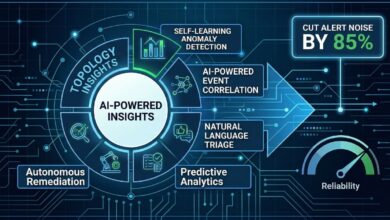
An Event Intelligence System takes a fundamentally different approach. Instead of optimizing a single phase, it compresses the entire incident lifecycle across detection, triage, diagnosis, and remediation. That is how teams move beyond incremental MTTR improvements and achieve reductions of up to 70 percent.
Scout’s platform is built to deliver this outcome. Here’s how.
Root Cause Analysis Worksheet for Faster Incident Diagnosis
Why Your MTTR Is Still Too High Despite Better Monitoring
The majority of teams don’t have a detection problem. They have a diagnosis and action problem. The monitoring stack fires off alerts within seconds, but that’s where the job really starts. The incident management clock still keeps ticking through four distinct phases, and each one adds minutes or hours to your average resolution time:
- Detection (5–15 min): Alerts fire off, but they get buried under excessive alert noise. A typical enterprise generates 200+ alerts per day, and a as much as 85% of them are just duplicates or false positives. As a result, you get alert fatigue and miss the real signal.
- Triage (15–45 min): Someone has to actually read the alert, make a call as to whether it’s real, figure out who’s responsible for it, and escalate it up the chain. That’s where most of your MTTR quietly slips away.
- Diagnosis (30 min–3 hours): The engineer has to investigate systems, logs, and dashboards, look through logs, check the dashboards and try to work out what broke and if the culpable system is part of a bigger dependency chain. This is the phase that eats up most of the MTTR – and one that most tools barely touch.
- Remediation (15–60 min): Even when you do finally find the root cause, the engineer still has to go and execute the fix, then go verify it worked and finally close the ticket.Add all that up and you get an average MTTR of 4-6 hours for a P1 incident,and that’s not even out of the ordinary. It’s industry standard. very one of those hours can be pretty expensive.
How Event Intelligence Compresses Every Phase of MTTR
The reason point tools fail to make a dent in the MTTR metric is because they optimize one part of the cycle and leave the others untouched. An event intelligence system takes a more holistic approach and addresses all four phases simultaneously.
Phase 1: Detection: From hours to just a few minutes
Static thresholds often limit fast and accurate detection as far as fast detection goes. Using AI to learn from anomalies is the way forward, and that replaces those rigid rules with self-adapting baselines that get to know your environment from day one. That means that subtle deviations get caught and dealt with much quicker.
Scout’s platform uses AI-powered event correlation to chop down on those raw alerts by up to 85% . When your team isn’t faced with 200+ alerts every day but can just focus on 15-20 real incidents instead,you know exactly what’s going on.
Phase 2: Triage: from 45 minutes to just a few seconds
This is where Gen AI really shines. When you automate the process of turning raw log data into plain-English incident summaries, you can give every L1 engineer the contextual awareness of a top-level SRE in just seconds.
The impact is huge: far fewer unnecessary escalations, super fast routing to the right team, and a triage time that goes down from up to 45 minutes to just a few seconds.
Phase 3: Diagnosis: From hours to under 10 minutes
Diagnosis is often the longest part of MTTR. Scout shortens it by bringing together correlated events, affected services, recent changes, logs, dependency context, and past incident patterns into one focused view.
Scout uses AI agents to investigate incidents in a coordinated way Promise Theory s used to govern how those agents work together, defining what each agent will and will not do, so as not to model infrastructure components as “breaking promises.”
The result is faster root cause analysis, with clear summaries, likely causes, supporting evidence, and recommended next steps in minutes instead of hours.
Phase 4: Remediation: From Manual Fixes to Governed Autonomy
Knowing what went wrong is just half the battle. Incident response automation wraps things up for you tools that restart services, scale infrastructure, roll back deployments, and trigger ITSM workflows without getting in the way of a human. And every single action is kept in check: it’s governed by predefined policies, logged with a complete audit trail, and can even be reversed with the click of a button. That’s the difference between mindless automation and disciplined autonomy. AI-driven automation that operates within defined governance boundaries its place and respects the boundaries, with a human override always available.
The Numbers: What 70% MTTR Reduction Actually Looks Like
| Incident Phase | Before | With Scout | Estimated Time Saved |
| Detection | 2–4 hours | 3–5 minutes | Up to 70% |
| Triage | 15–45 minutes | Seconds (AI summary) | Up to 90%+ |
Diagnosis | 30 min–3 hours | Under 10 minutes | Up to 85% |
Remediation | 15–60 minutes | Automated (governed) | Up to 90% |
| Total MTTR | 4–6 hours average | 45–90 minutes | Up to 70% |
A 70% MTTR reduction is not the result of a single feature. It is the compound effect of faster detection, automated triage, AI-assisted diagnosis, and governed remediation working together.
This is why event intelligence systems can deliver outcomes that single-purpose monitoring or automation tools often cannot.
Beyond MTTR: Preventing Incidents Before They Escalate
The fastest incident to resolve is the one that never happens. Predictive incident prevention uses past patterns, capacity trends, and real time signals to flag potential issues before they become major problems. Got a disk trending toward full? It’s flagged three weeks out. A new deployment introducing a regression? Caught in minutes.
Scout’s customers are reporting a 92% success rate at preventing outages like this. That’s not just a reactive firefighting game anymore it’s an active prevention game.
And to measure it all, Scout’s Reliability Path Index (RPI) does all the heavy lifting for you, boiling down infrastructure health into a single, real time score (covering transit latency, app performance, server health, and user experience). One number for your engineers, one number for the board.
Calculate yours with our interactive RPI Assessment Tool.
Getting Started Without Replacing Your Existing Stack
You don’t have to blow up your entire monitoring setup to see these results. Scout integrates with the observability platforms you’re already using. Setting up takes all of five minutes. The platform starts to pick up your environment from day one and most teams see a noticeable reduction in alert noise within the first week.
The platform is SOC 2 Type II certified, HIPAA compliant, and built to handle the SLA monitoring and compliance requirements of enterprise, healthcare, and financial services. Every AI action is a transparent process and your data stays securely locked down.
Conclusion
MTTR remains high when teams only improve one part of the incident lifecycle. Event intelligence changes that by compressing detection, triage, diagnosis, and remediation together, helping teams reduce MTTR by up to 70%.
Scout is built to make incident response faster, smarter, and more proactive. Book a demo or start with a free RPI assessment to see where your MTTR stands today.
Frequently Asked Questions
It does it by squashing all four phases of the incident lifecycle at the same time: detection (no more static thresholds), triage (AI takes the lead on plain-English summaries), diagnosis (root cause analysis in seconds), and remediation (AI does the heavy lifting on fixes). Most tools only focus on one phase out of the four – event intelligence gets them all.
MTTR (Mean Time to Resolution) measures how long it takes to fix an incident after it’s found. It’s just a simple maths problem: (total resolution time) divided by (number of incidents). For example, if your team spent 300 minutes fixing 10 incidents, your MTTR would be 30 minutes. It covers the whole shebang: detection, triage, diagnosis, and remediation.
MTTD (Mean Time to Detect) is how long issues hang around before anyone spots them. MTTR measures how long it takes to fix them after they’re spotted. MTBF (Mean Time Between Failures) is how often you experience a failure. You need all three to get a complete picture of your reliability but MTTR directly measures how fast your team can get things running again.
Most monitoring tools only end up speeding up the detection process. But here’s the thing : detection makes up only 10–15% of the overall time it takes to get things back on track . The rest of the time is being spent on triage (figuring out who is responsible for it) , diagnosis (figuring out what went wrong with all those interconnected systems) , and then getting the fix in place. If your tools can’t tackle all of these phases then you’re guaranteed that your time to resolve won’t be changing much.
RPI is basically a single number that Scout uses to rate how healthy your infrastructure is , from transit latency, application performance right the way down to server health and user experience with it all being updated in real time. It means you can get a solid idea of how reliable your systems are in one glance , whether you’re an engineer or an exec.
Gartner puts the average cost of downtime at a whopping $5,600 per minute . And if you’re having a major incident that takes 4-6 hours to resolve that’s $1.3-$2 MILLION lost. Cutting your downtime by just 70% isn’t just about looking good on the charts it actually stops you losing money.
Well yes , you can use event intelligence to stop incidents from happening in the first place. Scout takes your historical data, plus what’s happening in real time and uses it to flag up problems before they become a major incident. Some of our customers have managed to stop 92 per cent of potential outages from happening – that’s before they even become a problem.
No, not at all. What Scout does is add a smart event intelligence tool to the top of whatever you already have set up. This supposedly makes it easier for you to get alerts consolidated, get more context and eventually work towards a more autonomous system. And honestly the whole thing probably takes about five minutes to get set up.
Yeah it is. Scout has SOC 2 Type II certification , is hipaa compliant, and even does enterprise grade encryption for both the data at rest and in transit. It’s built for industries like healthcare, finance and government, and has all the audit trails you’d expect when it comes to what the AI is actually doing.
Most teams see reduced alert noise and faster incident triage within the first week. Because Scout integrates with existing monitoring tools, deployment takes minutes not months.

Tony Davis
Director of Agentic Solutions & Compliance