Introduction
A compliance officer typically has three things open at once: the ISO/IEC 42001 standard, an inventory of every agentic AI system in production, and an audit timeline. Yet they almost always encounter the same problem. The policies are documented. The agents are running. The challenge is proving that every autonomous decision remained within its intended boundaries, and generating evidence that keeps pace as those agents learn, adapt, and evolve.
This is the fundamental governance challenge agentic AI introduces for ISO/IEC 42001 and every AI management standard that follows. Organizations are deploying autonomous agents at an unprecedented rate, while the December 2023 publication of ISO/IEC 42001 has given compliance teams the first internationally recognized framework for governing AI systems. Most organizations try to bridge the gap between the international standard and their AI architecture with more documentation. The organizations that scale successfully build governance into the architecture itself.
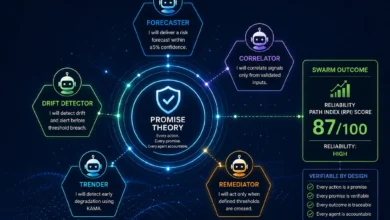
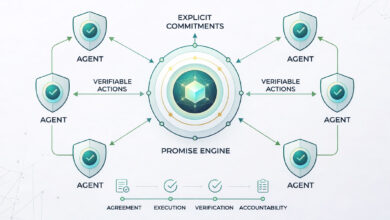
Scout takes that approach a step further by applying Promise Theory as the foundation for agent governance. Rather than relying solely on policies or centralized controls, each AI agent operates within explicit, verifiable commitments that define what it will do, under what conditions it can act, and how its decisions are validated. Every action can be traced back to those commitments, creating continuous evidence, explainable decision lineage, and built-in accountability that aligns naturally with the traceability, transparency, and oversight principles at the core of ISO/IEC 42001.
Why Agentic AI Breaks the Traditional Compliance Model
Traditional compliance frameworks were designed for software that changes through scheduled releases, documented approvals, and periodic reviews. Agentic AI doesn’t operate that way. Autonomous agents make decisions continuously, collaborate with other agents, adapt to changing conditions, and evolve over time. The pace of those decisions quickly outstrips governance models built around static documentation and quarterly audits.
The result isn’t simply more compliance work. It’s a mismatch between how modern AI systems behave and how organizations attempt to govern them. Documentation becomes outdated almost as soon as it is written. Human approval gates slow the very autonomy organizations are trying to achieve. Logs capture what happened after the fact, but rarely explain why an agent acted, what commitments it was operating under, or whether its behaviour remained within acceptable boundaries.
This is where most compliance strategies fail. They attempt to govern autonomous systems externally through policies, reviews, and manual controls. Promise Theory approaches governance differently. Instead of layering governance on top of autonomous agents, it embeds governance into the architecture itself by requiring every agent to make explicit promises about its behaviour and continuously validating whether those promises are kept. Governance becomes a property of the system, not a process wrapped around it.
What ISO 42001 Actually Requires
ISO/IEC 42001 doesn’t prescribe a specific technology stack or AI architecture. Instead, it defines the characteristics of a well-governed AI management system. Organizations must be able to demonstrate that AI systems are accountable, transparent, traceable, and appropriately managed throughout their lifecycle. At a high level, the standard expects organizations to demonstrate:
- Clear accountability for AI behaviour through defined roles and responsibilities.
- Ongoing risk management across the entire AI lifecycle.
- Transparency into how AI systems make and influence decisions.
- Traceability from outcomes back to the policies, models, and data that produced them.
- Appropriate human oversight for significant decisions.
- Governance over third-party AI systems and dependencies.
These aren’t merely documentation requirements. They’re governance requirements. The challenge is producing reliable evidence that these properties exist in dynamic, autonomous environments.
The Enterprise Guide to ISO 42001 for Agentic AI
Why Promise Theory Aligns Naturally with ISO/IEC 42001
Promise Theory approaches distributed systems from a fundamentally different perspective. Rather than assuming centralized control, it models autonomous actors that voluntarily make explicit commitments, promises, about the behaviour they will provide to others. Trust is established not by assuming compliance, but by continuously observing whether promises are fulfilled.
That model maps naturally to agentic AI. Every AI agent already operates autonomously. Promise Theory gives those autonomous agents a governance framework by making their intended behaviour explicit, measurable, and independently verifiable. Instead of asking an auditor to trust documentation written months earlier, the architecture continuously demonstrates whether agents are operating within the commitments they declared.
This distinction matters. Logs describe events after they occur. Promise Theory creates evidence that links every decision back to an explicit commitment, the conditions under which it was made, and the verification that the commitment was honoured, or broken. For compliance teams, evidence stops being something assembled before an audit. It becomes something the system generates continuously as it operates.
The Promise Theory to ISO 42001 Compliance Map
Every ISO 42001 theme above has a mechanism in Promise Theory that produces the evidence the standard expects. The mapping is concrete enough to put in front of an auditor.
Accountability with named roles
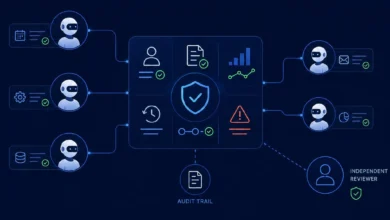
Each agent declares its own commitments, and verification is performed independently of the agent that committed. The system emits a per-agent commitment record and per-decision lineage showing which agent acted under which commitment.
Lifecycle AI risk management
Promise-keeping rates are tracked continuously rather than estimated quarterly. Broken commitments trigger a structured review. The system emits a real-time promise-compliance signal and documents escalations whenever promise-keeping degrades.
Traceability of decisions
Every autonomous decision carries lineage back to its commitment, the inputs it acted on, and the policy version in force at the time. The audit trail is produced as a side-effect of the system running. No manual reconstruction required.
Transparency to stakeholders
Declared commitments are readable and verifiable by parties outside the agent that made them. Stakeholders can see what an agent promised, what it delivered, and where deviations occurred.
Human oversight at decision points
Broken promises become the escalation trigger. Humans engage on a signal, not by sampling. Each escalation produces a documented event, a response record, and a resolution traceable through the same lineage system that captured the original decision.
Third-party AI risk
Vendor agents are required to declare commitments that an independent verification engine can check. Third-party AI risk management becomes contractual and architectural at the same time, rather than depending on vendor attestation alone.
Taken together, these architectural capabilities generate much of the evidence ISO/IEC 42001 expects organizations to demonstrate. Rather than creating audit artifacts after the fact, Promise Theory enables many of them to emerge naturally from the operation of the system itself.
Practical Scenarios
The questions compliance leaders actually get asked, with concrete answers.
The auditor asks: “Show me which agent made this decision and why.” Without Promise Theory, this is log archaeology across several systems, often inconclusive. With Promise Theory, the lineage record returns commitment, inputs, and policy version in a single query.
The board asks: “How do you prevent agent drift from creating compliance exposure?” Without Promise Theory, the answer is periodic model review, mostly retrospective. With Promise Theory, promise-keeping rate is tracked continuously, so degradation surfaces as a leading indicator before exposure becomes material.
The regulator asks: “Can you demonstrate human oversight of high-stakes agent decisions?” Without Promise Theory, you either gate every decision, which kills throughput, or sample, which leaves gaps. With Promise Theory, broken-commitment events become the oversight signal, and humans engage at the moments that matter with full lineage in front of them.
Procurement asks: “How do you manage compliance risk in third-party AI components?” Without Promise Theory, you trust the vendor’s documentation and inherit the exposure. With Promise Theory, vendor agents must declare commitments that your verification engine can check. The risk shifts from “we hope the vendor governed this well” to “we verified it independently.”
How Scout Operationalizes Compliance-Ready Agent Governance
Inside Scout’s Agentic Workforce Framework, agent governance is designed around declared commitments rather than wrapped around an existing architecture afterwards.Scout’s Promise Theory engine validates agent behaviour against those commitments through independent verification; the agent committing is not the agent judging it. Every autonomous decision carries structured lineage, and the record of promise-keeping accumulates as evidence.
The compliance implication is concrete. Most of the artifacts an ISO 42001 audit will request, such as accountability records, decision lineage, lifecycle risk signal, escalation history, and third-party agent verification, already exist as outputs of the running system. You aren’t producing them for the audit. You’re showing them.
Because governance is embedded directly into the architecture, the evidence required for standards like ISO/IEC 42001 emerges naturally from day-to-day operations. Decision lineage, commitment history, verification results, escalation events, and agent interactions become living records rather than artifacts assembled for an audit.
Scout is among the first platforms to operationalize Promise Theory specifically for governing autonomous AI agents. Rather than relying on centralized control, it provides a scalable governance model where accountability grows alongside the agent ecosystem, without sacrificing the autonomy that makes agentic AI valuable in the first place.
Actionable Takeaways for Compliance Leaders
The decisions worth making in the next quarter:
Map every ISO 42001 expectation to a system property, not a document. If a requirement can only be satisfied by paperwork, it’s at risk of falling out of compliance with the next agent update. Architecture-backed requirements stay satisfied. Documentation-backed ones drift.
Make declared commitments a non-negotiable for every AI agent in your estate. Internal or vendor-sourced. If an agent can’t tell you what it commits to, you can’t credibly govern it, and you can’t credibly report on it to an auditor.
Replace blanket approval gates with promise-failure escalation. Gates don’t scale, and they don’t satisfy auditors looking for genuine oversight. Promise-failure escalation puts humans in the loop at the moments that matter, with the lineage to back the decision.
Audit your evidence pipeline before your auditor does. When the next ISO 42001 audit asks “show me,” who runs the query, and how long does it take? If people are manually compiling records, the architecture is the gap.
Put commitment verification into vendor contracts. Treat it the way you treat encryption-at-rest or SOC 2 attestations: a baseline requirement, not a nice-to-have.
Conclusion
ISO 42001 compliance for AI agents is a documentation problem if you wait, and an architecture problem if you don’t. The teams that will pass audits cleanly over the next few years are the ones whose systems already produce the evidence the standard expects. Promise Theory is the framework that does that. Explore how Scout applies Promise Theory inside the Agentic Workforce Framework, embedding accountability, traceability, and independent verification directly into every AI agent.
Frequently Asked Questions
ISO/IEC 42001:2023 is the first formal AI management system standard. It sets out requirements for governing the design, deployment, and ongoing operation of AI systems. It matters for AI agents because agents act autonomously and change over time, which makes the standard’s expectations around traceability, lifecycle risk, and accountability much harder to satisfy with documentation alone.
No. Certification is performed by accredited bodies against the full AI management system, including leadership, policy, training, and ongoing processes, not just the technical architecture. Promise Theory makes the technical evidence ISO 42001 expects structurally available, which supports certification but does not constitute it.
Every autonomous decision in a Promise Theory governed system carries lineage back to the commitment that preceded it, the inputs it acted on, and the policy version in force at the time. That lineage is produced as a side-effect of normal operation, which means traceability evidence is available on demand rather than reconstructed after an incident.
A structured record showing which agent made each decision, the commitment under which it acted, the inputs available at the time, the policy version in force, the outcome, and whether the outcome matched the commitment. Where a commitment was broken, the trail also shows the escalation, the response, and the resolution. The trail is queryable, not reconstructed.
Broken commitments become the escalation signal. Rather than sampling outputs or gating every decision, humans engage when an agent’s behaviour falls outside its declared commitment, with the full lineage of the decision in front of them. That produces auditable oversight at the moments where oversight actually matters.
Partially. You can layer commitment publication and independent verification onto an existing platform and get most of the lineage and accountability benefits. Deeper benefits of error containment, drift signal, and third-party verification at scale require agents designed under the model rather than wrapped in it.
By making commitment declaration and independent verification a contractual requirement of every vendor agent in your estate. Vendor risk shifts from “we trust the vendor’s documentation” to “we verify the vendor’s commitments through our own engine.” That changes how third-party AI exposure is governed.
An AI management system is the organisation-wide structure of leadership, roles, policies, training, and ongoing processes that ISO 42001 expects. Promise Theory is an architectural pattern for the technical layer. They aren’t substitutes. The management system tells you what to govern. Promise Theory makes it possible to actually do so at an agentic-AI scale.
By producing the artifacts ISO 42001 expects as outputs of normal operation: per-agent commitment records, per-decision lineage, real-time promise-compliance signal, escalation records, and independent verification of third-party agents. The evidence is available on demand rather than compiled for the audit.
Treating the standard as a documentation exercise rather than an architectural one. Documentation written at deployment goes stale when the agents change, which agents always do. The teams that succeed treat each ISO 42001 expectation as a property their system has to produce continuously, not a record they have to write once.

Tony Davis
Director of Agentic Solutions & Compliance