An AI agent that drafts a report may still expose sensitive data or produce misleading information. When an agent can also approve refunds, modify customer records, or restart production systems, its actions can create immediate business consequences.
As enterprises deploy autonomous agents, AI risk management for agentic AI must extend beyond pre-launch reviews. Operations, security, and risk leaders need to understand what agents can access, what could go wrong, and whether safeguards work during execution. This five-step framework and checklist provide a starting point for defining responsibilities, evaluating controls, and deciding when to expand autonomy.
What Is AI Risk Management for Agentic AI?
AI risk management for agentic AI is the ongoing process of identifying, assessing, mitigating, monitoring, and reviewing risks created when autonomous agents make decisions and execute actions.
AI agent governance establishes ownership, permissions, and operating boundaries. Risk management evaluates possible failures within those boundaries and determines whether controls are effective.
In practice, governance and risk management overlap: governance assigns accountability and decision rights, while risk assessment and monitoring inform the controls those owners approve.
Why Agentic AI Requires a Different Risk Management Approach
Traditional AI risk management addresses model accuracy, bias, security, and explainability. Agentic AI introduces additional operational risks because agents can call tools, modify records, and coordinate workflows without human approval at every step.
An incorrect recommendation may be corrected before use. An incorrect action could already have transferred money or interrupted a service.
Connected APIs expand potential exposure, while multi-agent workflows can spread errors across systems.
Joint cybersecurity guidance identifies privilege, design and configuration, behavior, structural, and accountability risks associated with agentic AI. Managing these risks requires continuous evaluation rather than relying entirely on initial approval.
Get the AI Agent Risk Assessment Checklist.
A Five-Step Enterprise AI Risk Management Framework
The NIST AI Risk Management Framework uses four functions: Govern, Map, Measure, and Manage. Enterprises can apply these principles through five practical steps.
1. Identify
Inventory approved, third-party, and shadow AI agents. Record each agent’s owner, purpose, connected tools, data access, and permitted actions.
Document potential failures, including unauthorized transactions, exposed information, and unintended actions.
An agentic transformation assessment can help organizations evaluate their current AI adoption and identify opportunities for better oversight.
2. Assess
Evaluate risks using likelihood, impact, reversibility, and detectability.
In a hypothetical refund workflow, an agent might issue duplicate payments. Transaction limits and duplicate checks could reduce exposure, but teams would still need to test their effectiveness and assess residual risk: the risk remaining after safeguards are applied. This is an illustrative failure scenario, not a customer outcome.
3. Mitigate
Apply controls proportional to risk. A document summarizer may require read-only access, while an agent handling financial transactions may need spending limits and human approval.
4. Monitor
Track tool usage, policy violations, unexpected actions, and behavioral drift, meaning changes in how an agent behaves over time. Assign an owner to investigate alerts and document the response.
Continuous verification also helps determine whether agents are operating as expected. This evidence is essential for developing trusted AI agents and making informed decisions about autonomy.
5. Review
Reassess agents after significant changes to models, permissions, tools, or workflows. Use incidents and monitoring results to improve controls.
Key Risk Mitigation Strategies for Agentic AI
Enterprise AI risk management requires safeguards that operate throughout an agent’s lifecycle.
Least-privilege access. Restrict agents to the tools, data, and permissions necessary for their assigned tasks.
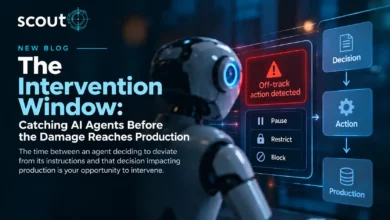
Runtime controls. Enforce transaction limits, prohibited actions, approval thresholds, and stop conditions. These safeguards are particularly important during the intervention window, before harmful actions affect production.
Human oversight. Allow low-risk, reversible actions within approved limits. Require additional verification or human authorization for higher-risk activities.
Adversarial testing. Evaluate how agents respond to prompt injection, manipulated inputs, unexpected tool behavior, and operational failures.
Incident response. Establish procedures to suspend agents, revoke permissions, preserve evidence, and recover affected systems.
Traceability. Maintain records of agent actions, applied policies, and outcomes to support investigations and risk reviews.
Together, these controls help organizations reduce exposure without unnecessarily restricting automation.
Managing Risks Across Multi-Agent Systems
Multi-agent systems introduce additional risks when agents delegate tasks, exchange information, or depend on each other’s decisions.
The OWASP Top 10 for Agentic Applications highlights insecure inter-agent communication and cascading failures.
Enterprises must establish clear delegation boundaries, accountability, and end-to-end visibility.
Scout Agentics applies Promise Theory specifically to agent governance. Agents declare explicit commitments, and their behavior is evaluated against those commitments.
In plain language, each agent states what it is expected to do, and reviewers compare its observed actions with that commitment. For example, an agent could commit to reading approved records without changing them; system permissions would enforce the read-only boundary. Declared commitments complement access controls and testing rather than replace them. Learn more about Promise Theory for Multi-Agent AI Systems.
Scout’s Mission Control provides centralized visibility into agent activity, helping teams monitor and govern their AI workforce. These capabilities complement existing security and risk management controls.
AI Risk Management Checklist
Use this checklist to structure a deployment review. For each item, record the accountable owner, supporting evidence, and any unresolved risk; a checked box alone does not demonstrate that a control works:
- Every agent has a documented purpose and owner.
- Access permissions follow least-privilege principles.
- Failure scenarios and residual risks are assessed.
- Runtime limits and approval thresholds are enforced.
- High-risk actions receive appropriate oversight.
- Actions are traceable across connected systems.
- Incident-response procedures are established.
- Risk assessments are updated after significant changes.
Conclusion
AI risk management for agentic AI is not a one-time approval. It requires continuous identification, assessment, mitigation, monitoring, and review as agents and business workflows evolve.
Enterprises should begin with lower-risk tasks, establish measurable safeguards, and expand autonomy when operational evidence supports it. For the business, the aim is clearer deployment decisions, fewer avoidable disruptions, and faster investigation when something goes wrong; teams should measure these outcomes rather than assume them.
Explore Scout Agent Studio to evaluate whether its controls, oversight, and traceability fit your workflow. Bring one proposed use case and use the checklist above to discuss access boundaries, approval requirements, and evidence needs.
Frequently Asked Questions
It is the continuous process of identifying, evaluating, and controlling risks associated with autonomous AI agents and their actions.
Governance defines policies, ownership, and permissions. Risk management identifies potential failures, assesses exposure, and evaluates safeguards.
Major risks include excessive permissions, prompt injection, data exposure, unauthorized actions, behavioral drift, and cascading failures.
Evaluate likelihood, impact, reversibility, and detectability. Reassess the remaining risk after controls are applied.
No. Oversight should reflect the action’s risk level, with stronger approval requirements for consequential or irreversible activities.
No. It supports alignment with frameworks such as NIST AI RMF and ISO/IEC 42001, but compliance depends on organizational controls and applicable requirements.

John Balsavage
President