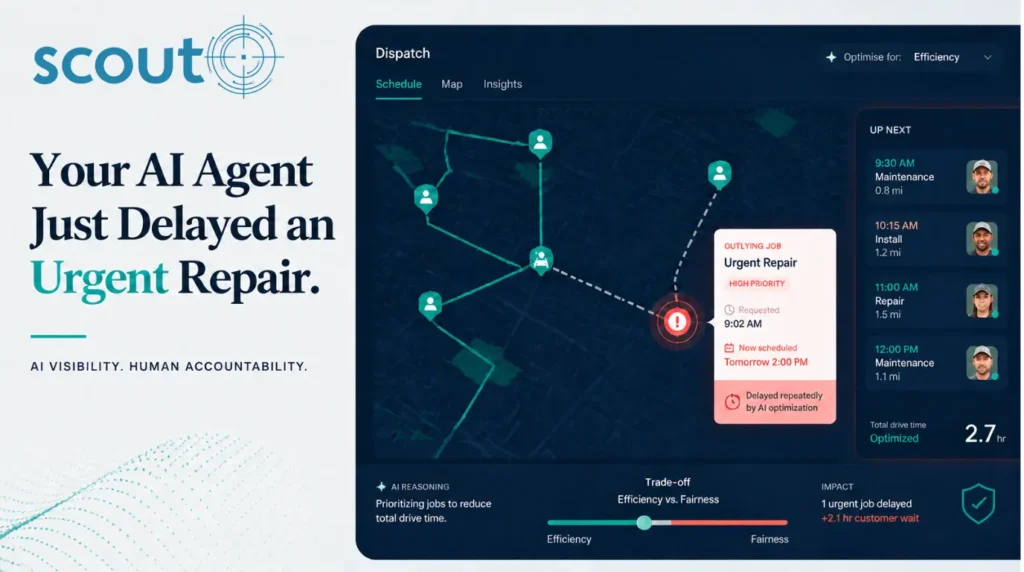
Imagine an AI scheduler that cuts travel time, fills technicians’ calendars, and keeps appointments moving.
Then a customer calls: their urgent repair has been pushed back again. The workflow keeps favoring nearby jobs, so an outlying site keeps losing its slot.
This hypothetical example exposes a problem a busy dashboard can hide. Who decided that a shorter drive mattered more than the customer’s wait?
Responsible AI for autonomous agent workflows starts with questions like that. Here are six checks to make before giving agents more room to act.
Start With the Customer Who Keeps Getting Bumped
Responsible AI asks how a system’s decisions affect people: who benefits, who waits, what information gets used, and who can put things right. For a multi-agent workflow, those questions follow every handoff. An intake agent may miss urgency. A scheduler may optimize the route. A booking agent may send the delay notice. Each step can look reasonable while the customer gets a poor result. NIST’s AI Risk Management Framework treats trustworthiness as context-dependent. Better performance on one measure does not establish that the whole system is trustworthy. In this example, travel time belongs beside waiting time and urgent-service commitments.
Ready to Give Your AI Agents More Room to Act?
Six Questions to Ask Before the Next Booking Goes Out
Bring these questions to the people who dispatch technicians, handle complaints, and depend on the service. Their answers should shape what the agents are allowed to do.
1. Who keeps losing when the numbers improve?
Ask the dispatcher about the jobs that are hardest to place. Ask the support team which customers keep calling back. Ask customers what a delay actually costs them. These conversations can reveal consequences that a route-efficiency report misses.
Give the scheduler boundaries alongside its efficiency target: urgency, contractual commitments, and limits on repeat postponements. Compare similar jobs before drawing conclusions. A longer wait in one location deserves investigation, but geography alone does not establish unfair treatment.
Then vary the request. Does the workflow handle the same need appropriately when someone uses another supported language or gives fewer details? Decide in advance which differences make sense and which need investigation.
2. Does the routing agent need all that customer data?
Map the information needed for each decision. A routing agent might need a service address, equipment requirements, and appointment window. It may have no reason to receive unrelated customer correspondence or billing history. Connect these decisions with your AI agent security controls. Apply the same data review to intermediate summaries, agent memory, notifications, and logs, setting retention and access according to each record’s purpose.
For an accessibility-related scheduling need, pass along the practical requirement to the person who needs it. Keep unrelated personal details out of the handoff. Involve privacy specialists before collecting sensitive information for fairness analysis.
3. Did “unconfirmed” quietly turn into “confirmed”?
Suppose intake records “customer availability unconfirmed.” The scheduler proposes a time, and the booking agent sends a confirmation. Somewhere along the chain, a possibility became a commitment. Prevent that by keeping verified facts, estimates, and missing information distinct. Each handoff should carry the source, its age, open questions, and any conditions on the recommendation.
Make the booking agent check availability before it commits the visit. Test whether that check still happens when an earlier agent produces a confident-sounding summary.
4. Can a person stop the decision in time?
An urgent job lands in a supervisor’s review queue. The queue is backed up, but the scheduler is ready to move the appointment. What happens next? Define that behavior before launch. The reviewer needs the original request, the reason for the change, alternatives, and authority to intervene. Test the queue under realistic demand. If nobody responds, one possible fallback is to keep the existing appointment and alert a staffed service channel. Choose the fallback according to the consequences of waiting or acting.
5. What happens when the customer says, “That’s wrong”?
A customer should be able to find out why an appointment changed and reach someone who can correct it. Explain where AI contributes, give reasons grounded in the actual decision record, and make the review route easy to find.The OECD AI Principles support transparency and the ability to challenge adverse outputs.Let people add missing information without starting over. Check generated explanations against the record so the system does not invent a plausible reason after the fact.
6. Who calls the customers already affected?
Changing the scheduling rule helps future bookings. The customers already postponed still need attention. Name the team that will find affected visits, arrange appropriate corrections, contact customers, and check that the fix worked. Build that responsibility into the workflow before launch.NIST’s AI RMF Playbook includes feedback, appeals, overrides, incident response, and recovery. The OECD’s February 2026 guidance also covers remediation and ways to raise concerns.
Try to Break the Workflow Before Customers Depend on It
A useful test follows the request all the way to the customer’s calendar. The Alan Turing Institute’s CETaS recommends assessing agent deployments in their operating context, including tools, workflows, and human interactions. A correct answer from one agent cannot establish that the full service works.
Start with situations your service team already recognizes:
| Test Situation | What the Team Should Verify |
|---|---|
| Urgency is unclear | The workflow asks for clarification or routes the case for review before making a consequential scheduling change. |
| Availability data is outdated | The booking step checks current availability before committing a visit. |
| A customer has already been deferred | The workflow considers cumulative delay against the agreed service rules. |
| The review queue is unavailable | The fallback preserves the case and sends it to a functioning support route. |
Vary the wording and supported input formats. Run cases more than once where behavior can change. Inspect the handoffs and the final customer record. A passing test should show that the promised service outcome happened, with unresolved cases held for review.
Your Dashboard Needs to Show the Wait, Too
Keep the travel-time savings visible, then add measures that reveal the customer experience. NIST recommends choosing evaluations that fit the deployment context and include input from affected people.
For this example, a practical scorecard could include:
- Repeat postponements. The share of visits rescheduled more than once, reviewed alongside urgency and service commitments.
- Decisions corrected after review. The share of reviewed cases changed because the original decision was wrong. Keep the number of reviewed cases visible.
- Time to human review. How long people wait for a substantive response, including cases still waiting.
- Time to remedy. How long a confirmed problem remains unresolved, including open cases.
Read the numbers alongside customer feedback. Compare similar service situations, protect personal information, and agree thresholds with operational and risk owners. Sample decisions nobody challenged, too. A quiet inbox does not tell you how many people received a wrong decision.
Where Scout Fits Into the Workflow
Scout Agent Studio provides workflow orchestration, permissioned tool and data integrations, human-in-the-loop controls, policy enforcement, and agent traceability. These capabilities can support the execution and review mechanisms discussed here.
For the scheduling example, ask which control checks urgency, which preserves uncertainty, and where a supervisor can intervene. Your team still owns the service rules, privacy decisions, reviewer preparation, and correction process. Connect each proposed control to a real decision and a named owner.
Before You Give the Agents More Room to Act
Use this as a launch conversation. For each item, ask: can we show that it works?
- Affected people and foreseeable harms have been identified.
- Service objectives include measurable quality targets and criteria for treating comparable cases consistently.
- Each agent receives only the information its task needs.
- Uncertainty remains visible across handoffs.
- Reviewers have evidence, time, and authority to intervene.
- Fallback arrangements have been tested when review is unavailable.
- People can understand decisions and request corrections.
- A named team can repair previously affected cases.
- Outcome measures and feedback inform changes.
Start With One Workflow and One Consequence That Matters
Return to the customer waiting for the urgent repair. Can your team explain the delay, catch a mistaken decision, and arrange a correction? Start there. Choose one workflow, test its awkward cases, and review the results with the people running and using the service. Expand after the evidence supports it. The goal is a service people can rely on, including when an agent gets something wrong.
Explore Scout Agent Studio to discuss one workflow, its approval points, and the evidence your team would need before expanding automation.
Frequently Asked Questions
It means designing agent behavior around appropriate outcomes for people, with attention to fairness, privacy, transparency, human oversight, and ways to correct mistakes.
They overlap. AI agent governance establishes organizational authority and oversight. Responsible AI also examines how individual workflows affect people and whether their outcomes can be understood, questioned, and corrected.
Use human review where consequences, uncertainty, or difficulty of correction justify it. Routine actions may run automatically within tested conditions, with a clear fallback for exceptions.
Compare errors, delays, and corrections across comparable situations. Investigate unexplained differences, involve affected users, and protect personal information used in the assessment.
Contain further harm, identify affected cases, assign a responsible team, and arrange appropriate correction. Communicate with affected people and confirm the remedy worked before expanding automation again.

John Balsavage
President